



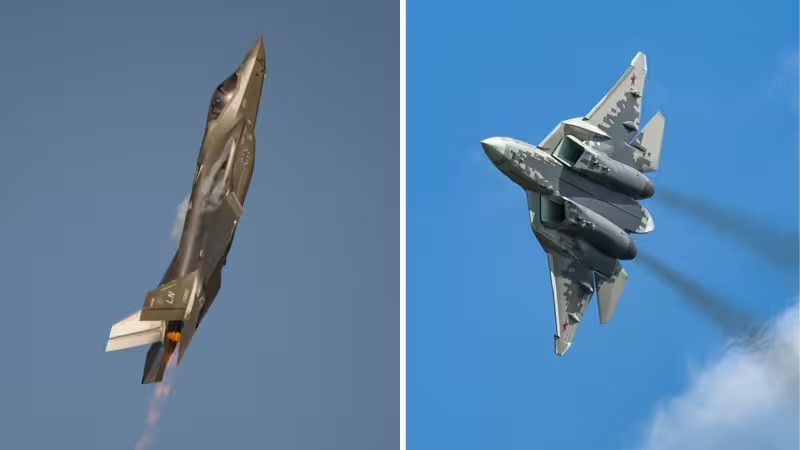
The F-35 Lightning II remains the stealthier of the two fifth‑generation fighters; open‑source estimates put its radar cross‑section at roughly 0.001 to 0.005 square meters, while most estimates place the Su‑57’s radar cross‑section significantly higher.
Questions about Rostec Su‑57 stealth capabilities often focus on that gap. Both aircraft are built to be less visible to radar and to carry weapons internally, but they were designed around different priorities: one around minimizing detectability and building a fused battlespace picture, the other around speed, maneuverability and long‑range engagement.

On the F‑35, low observability is a design mandate, not an add‑on. Its airframe shapes, recessed engine inlets, internal weapons bays and radar‑absorbent coatings work together to reduce returns across radar bands. Those signature‑reducing measures are paired with a tightly integrated sensor suite — the AN/APG‑81 AESA radar, the Electro‑Optical Targeting System and the Distributed Aperture System — that fuse inputs into a single picture. Pilots receive that fused information directly instead of juggling separate sensor feeds, which is why most analysts call the F‑35 the benchmark for situational awareness among operational fighters.
The Su‑57 incorporates stealth shaping and radar‑absorbing materials as part of its package, and it carries the N036 Byelka AESA radar plus multiple infrared search‑and‑track systems. Those elements make the Su‑57 harder to detect than older Russian fighters such as the Su‑35, but its airframe and engineering choices reflect compromises for aerodynamic performance: speed and high‑angle maneuverability were given more weight in the design trade‑offs than absolute minimal signature.
That trade‑off creates the central friction in comparisons. The Su‑57 clearly has stealth features, yet the absence of a closely agreed‑upon radar cross‑section figure for the Su‑57 leaves a gap: reliable open‑source estimates consistently rank its RCS well above the F‑35’s 0.001–0.005 m2 window, but they do not land on a single number. At the same time, far less is publicly known about how mature or sophisticated the Su‑57’s sensor‑fusion architecture is relative to the F‑35’s fielded system. So the comparison splits into two linked questions — how small is the Su‑57 on radar, and how well can its sensors convert whatever advantage it has in speed or maneuver into survivable tactics in a contested airspace?
For operators and analysts weighing platforms, those questions have practical consequences. A smaller radar signature reduces the need for risky approaches and allows more freedom to close with adversary targets; superior sensor fusion reduces pilot workload and improves target prioritization and survivability. The F‑35, by the numbers and by the shape of its systems, prioritizes both. The Su‑57’s strengths lie elsewhere: its profile favors kinetic performance and engagements at longer ranges, where signature and networking still matter but in different operational mixes.
The unresolved pieces matter for procurement and tactics. Without a precise, widely accepted RCS figure for the Su‑57 and without public evidence that its sensors are fused to the benchmark level of the F‑35, assessments must rely on the clear strengths each design emphasizes. The F‑35 is the stealthier platform and sets the current operational standard for situational awareness; the Su‑57 reduces detectability relative to legacy designs while accepting higher radar return in exchange for speed and maneuverability.
For anyone deciding between the two or trying to anticipate how they would perform against one another on a contested battlefield, the next decisive data would be firm, validated measurements of the Su‑57’s radar signature and independent demonstrations of its sensor‑fusion maturity. Until those appear, the practical conclusion is straightforward: the F‑35 keeps the edge in low observability and fused situational awareness, while the Rostec Su‑57 brings design choices that favor a different set of combat priorities.



