



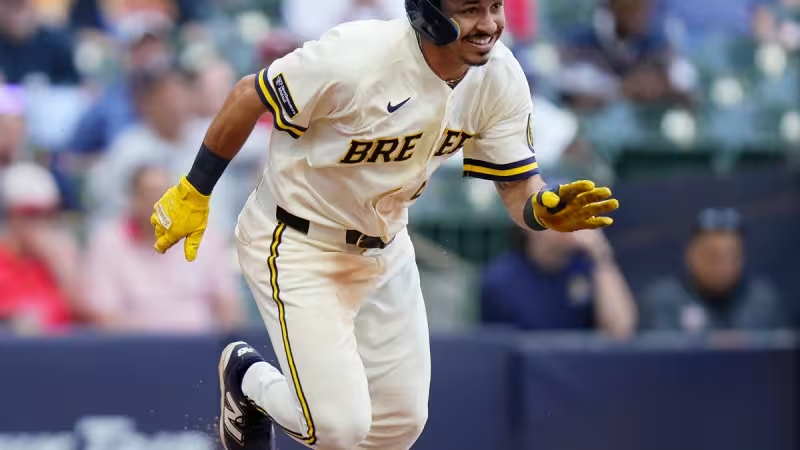
David Hamilton says he drops down bunts about 10 times a day in batting practice, and this season those routine reps have turned into something unusual: nine bunt hits, the most in Major League Baseball.
That sudden production has changed how the Milwaukee Brewers use Hamilton. After 204 games and just three bunt hits in parts of the 2023–25 seasons with the Boston Red Sox, Hamilton joined Milwaukee and, by his own account, was told by club brass that his legs would be his meal ticket. He has responded by becoming a regular in the lineup, playing both third base and shortstop while batting.220 with a.308 on-base percentage.

The numbers underline the impact. Hamilton’s nine bunt hits lead the majors by a wide margin; he has 13 infield hits overall, second in MLB behind Chandler Simpson’s 20. He has also swiped 10 bases in 13 attempts, and his average home-to-first time is 4.01 seconds, the second-fastest mark in the league behind Simpson’s 3.98. That blend of speed and placement is precisely what the Brewers wanted when they asked him to turn his legs into offense.
“A guy like David Hamilton can turn one hit into a double, maybe even a triple, just with the ability to steal bases,” first base coach Spencer Allen said, summing up why Milwaukee has leaned into small-ball with Hamilton at the bottom of the order.
Hamilton frames the change as partly situational and partly personal. In Boston, he said, bunting came up in conversations but he never felt comfortable doing it: “They definitely talked about it. I just wasn’t comfortable doing it,” he said. He added that inconsistent playing time might have been a factor: “I don’t know why. Maybe it’s because I wasn’t getting at-bats all the time.”



In Milwaukee, the conversation was different. President of baseball operations Matt Arnold and manager Pat Murphy reportedly encouraged Hamilton to lean on his speed. Hamilton says he isn’t radically altering his approach—“I don’t feel like I’m really doing anything different”—but he’s tightened the details: “I’ve just got to see the ball down first. That’s the main thing.”
The friction is obvious. Hamilton insists he’s doing the same things he did in Boston, yet the results have diverged sharply. “Honestly, I could not tell you how I'm having this success,” he said. He also described a mechanical tweak: “Trying to run before I bunted the ball,” a suggestion he’s taken seriously enough that bunting is now an explicit part of his identity at the plate: “Yeah, I’m having success with it right now. Definitely want that to be part of my game.”
Milwaukee’s embrace of Hamilton’s speed has practical effects beyond the box score. With 13 infield hits and elite home-to-first times, Hamilton forces infielders to make plays they otherwise might not, and opposing defenses must respect the threat on bunts and soft contact. For perspective, Brandon Lockridge is tied for sixth in the majors with four bunt hits — less than half Hamilton’s total.
What remains unresolved is whether this pace can hold. Hamilton has been in the Brewers’ lineup most days and the club is clearly giving him opportunities to leverage speed over power. But the leap from three bunt hits across 204 games in Boston to nine in a chunk of a season with Milwaukee raises the single consequential question: can Hamilton sustain his bunt-heavy production long enough to change how pitchers and defenses approach him week after week?
The answer will shape not only Hamilton’s role but how Milwaukee builds offenses around speed. For now, the sequence is simple: he practices bunts, he drops them in games, and the scoreboard shows nine — a small number that has, for the moment, become a big weapon. Whether it stays that way is the story that follows.



