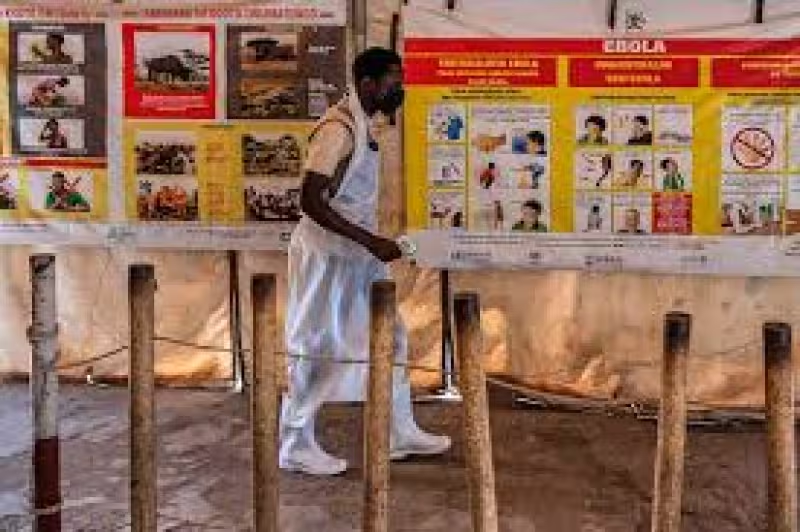
On Thursday, June 4, 2026, a health worker was photographed walking past Ebola warning and instruction posters at a temporary health clinic at the Mpondwe border crossing between Uganda and the Democratic Republic of the Congo.
The image captures the worker moving along a cordon of printed guidance and alerts mounted where people cross the frontier, a visible measure of concern at one of the bilateral transit points. The photograph and its caption record that the posters were displayed at a makeshift clinic established at Mpondwe the same day.

The story’s headline adds another, more consequential claim: traders face big losses after Uganda closes the Congo border over Ebola contagion fears. That line places the photograph inside a larger emergency frame — a border shut in response to contagion worries and an immediate economic hit to cross-border commerce.
Why the photograph matters now is straightforward: Mpondwe is a functioning link between the two countries, and the posters show public-health messaging and triage infrastructure placed directly where people move goods and travel. The visual evidence of a temporary clinic makes the risk-management response visible on the ground even as reporting around it raises alarms about border measures and losses.
There is an immediate consequence suggested by the headline: if the border is closed, traders who rely on Mpondwe’s flows would lose market access and income. The headline frames that consequence as significant — “big losses” — but the photograph itself does not document trade impacts, shipments halted, or official closure orders. The image supplies the public-health detail; the headline supplies the economic claim.
That gap is the story’s tension. The photograph confirms that Ebola warning and instruction posters were posted and that a temporary health clinic operated at the crossing on June 4. It does not confirm the scale of border restrictions, the mechanics of a closure, which checkpoints were affected, or how long any measures would last. The headline asserts a closure and economic pain, but the visual record and its caption stop short of those operational details.
Readers seeking certainty — traders, transporters, market authorities, and public-health officials — face an immediate information shortfall: was movement along Mpondwe halted, partially restricted, or only subject to health screening and signage? The photograph shows the presence of health measures; it does not document travel bans, checkpoints sealed with barriers, or enforcement activity that would amount to a formal closure.
That distinction matters because the type of action taken at a border determines the human and economic consequences. A full closure would suspend routine cross-border trade and risk the losses the headline warns of. Enhanced screening or temporary clinic operations, by contrast, are mitigating measures intended to detect and limit contagion without entirely stopping commerce. The available evidence contains only the latter, not the former.
What happens next is the unresolved — and most consequential — element. The photograph is time-stamped: June 4. The headline links that scene to a closure and to traders’ losses. The reporting to follow should establish whether officials ordered a shutdown, the geographic reach of any restriction, and how long it will remain in place. Those facts will determine whether the moment pictured is a precautionary checkpoint or the beginning of a larger economic disruption.
Until those operational details are confirmed, the photograph stands as a clear record of contagion-related messaging and a temporary clinic at a major crossing, and the headline stands as a claim of closure and economic harm. The next authoritative step for readers and those affected is plain: seek official clarification on the status and duration of any border measures at Mpondwe to understand whether the posters mark a temporary health posture or the start of a trade stoppage that would translate into the “big losses” the headline predicts.