




On Friday, June 5, the Chicago Bears announced their board of directors voted to advance stadium project development in Hammond, Indiana.
Team leaders George McCaskey and Kevin Warren said the vote will further focus the Bears’ stadium efforts on Hammond, part of a process the franchise says follows months of searching and local negotiations. The Bears added that "The Chicago Bears have exhausted every opportunity to stay in Chicago, which was our initial goal," and that "There is not a viable site in the city."

The decision tightens the team’s realistic choices: the Bears have said the only sites under consideration are in Arlington Heights and Hammond. A person familiar with the situation told Sports the Bears will ultimately move to Hammond or Arlington Heights and that remaining in downtown Chicago is not viewed as a viable alternative.
That narrowing matters because Soldier Field sits at the center of the question. The Bears have played their home games in Chicago since 1921, except for the 2002 season when they played in Champaign while Soldier Field was renovated — the downtown stadium the franchise would be leaving if a Hammond plan proceeds.
Hammond officials greeted the announcement as a win. Hammond Mayor Thomas McDermott Jr. said, "The Chicago Bears chose Hammond, Indiana because they see what I have said for years: Hammond is a successful city of opportunity and possibility, an excellent choice for such a significant investment," and added that "The city of Hammond and the entirety of Northwest Indiana will benefit from this transformative investment." He credited state and local leaders for helping push the deal over the goal line.

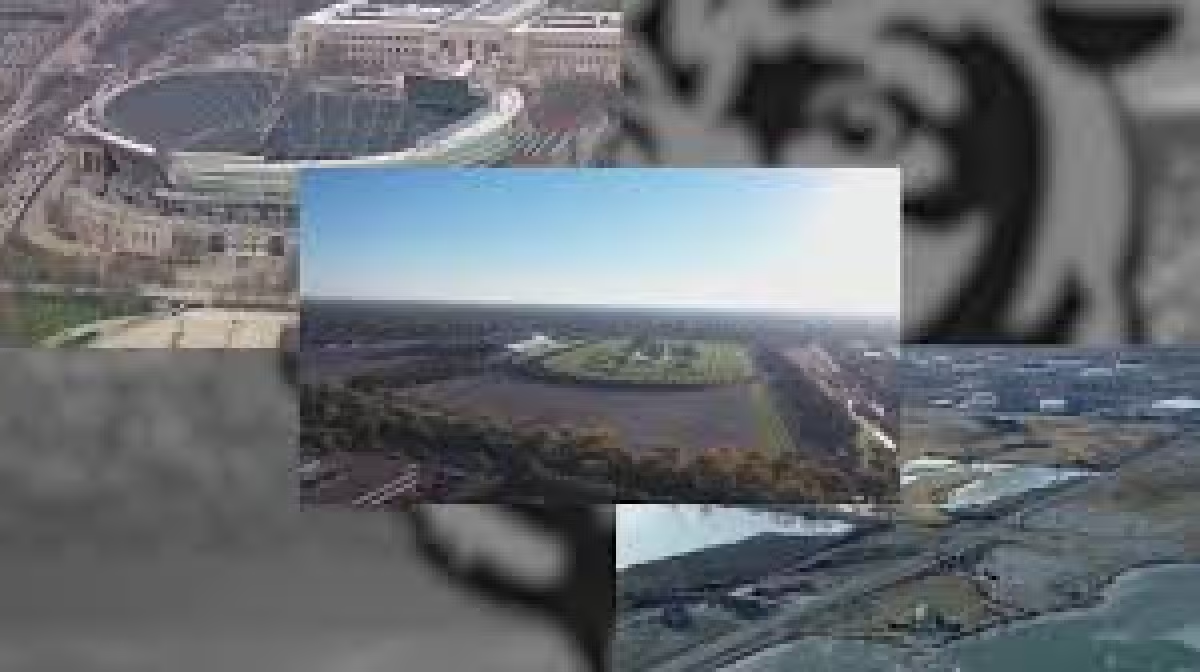

Chicago Mayor Brandon Johnson cautioned that the vote is not a transfer of the team. "Over the last several years the Bears have stated their intentions in multiple jurisdictions, today's announcement is not surprising," he said, and warned that "It's also not surprising the Bears officials have stated this vote does not mean a move to Hammond is a done deal." Johnson added a practical threshold for Chicago’s continued involvement: "Without a final site selection, until we see shovels in the ground in Hammond, the City of Chicago will continue to engage in discussions grounded in the interests of our residents."
The friction here is straightforward: the Bears framed the board vote as a formal step toward Hammond, while city officials in Chicago insist the outcome is far from settled and note that no specific Hammond site has been chosen. The Bears previously warned season-ticket holders that the search would expand to Indiana after Illinois politicians said the stadium project "project will not be a priority in 2026."
Last month the team had said it had "exhausted every opportunity to stay in Chicago" and reiterated that the only remaining options are Arlington Heights and Hammond. That sequence — public acknowledgement that Chicago lacks a viable site, followed by a board vote to focus on Hammond — is the clearest, dated movement in the stadium saga to date.
What happens next is the crucial unknown. The Bears and Hammond must pick an exact site and clear the layers of planning, approvals and financing before any ground is broken. Until a site is selected and construction begins, Chicago retains leverage and residents retain uncertainty about Soldier Field’s long-term role. The single most consequential unresolved question: which specific parcel in Hammond, if any, will be chosen and when will shovels actually hit the ground?
Observers looking back at Soldier Field’s recent event history can point to moments when the stadium drew national attention — for example, the sold-out USA vs Germany tuneup in Chicago — but the next true milestone will be concrete: a chosen site and a construction timeline that confirms whether the Bears are genuinely moving beyond the city they’ve called home for more than a century.



