



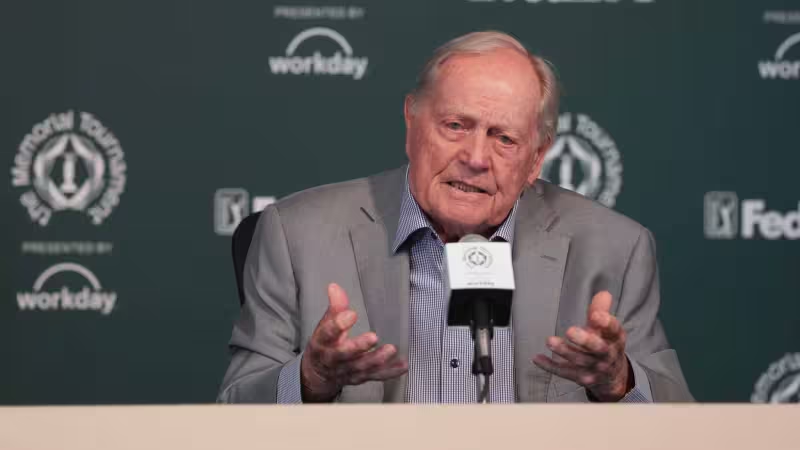
“Well, I don’t want to comment on the [PGA] Tour’s schedule because I’m not exactly in favor of what they’re doing right now,” Jack Nicklaus told reporters Tuesday at Muirfield Village, during the 50th playing of the Memorial Tournament. He said he wants to sit down with Brian Rolapp and Jay Monahan and make his case in person.
Nicklaus left little doubt where he stands: he voiced sharp concern that the Tour’s leadership is moving toward compressing the season into six months, a change he warned would crowd marquee events and stamp out the breathing room for smaller tournaments. “I mean, I hate to see tournaments bunched too much together with too many big tournaments too close together. That’s a problem, I think,” he said.

The weight of the objection came in concrete examples. Nicklaus pointed to the Cognizant Classic in Florida and named Pebble Beach, Los Angeles, Bay Hill and The Players when sketching a calendar he fears would pinch midlevel stops between flagship weeks. “What chance does that tournament have? I mean, it sits right in the middle of those. They don’t have a chance,” he said.
Nicklaus, an 18-time major winner, framed the issue both for events and players. He noted that smaller tournaments struggle to stand out when they are sandwiched between big-field weeks and that top players will find it harder to commit to grueling stretches. “The other tournaments also say, you know, I got four out of five. It’s hard for guys to play that,” he told the assembled press.



He also made the human case for spacing. Nicklaus said he could manage “a couple weeks in a row, maybe three weeks in a row,” but he needs off weeks to “recharge the batteries.” That, he implied, is not just an indulgence of veterans but a practical limit on how much elite players can be expected to compete without risk to performance or health.
Context matters here: the Memorial Tournament has changed little in decades, and its 50th staging provided a stage for a living icon to push back publicly. His timing matters too — the Tour’s overhaul plans are active now, and a compressed, six-month schedule would reshape which weeks carry the most weight and which events become afterthoughts.
The friction is plain. Nicklaus said he is not in favor of the plan, but Tour leadership appears intent on the overhaul. That gap — between a legend’s public objections and an organization pressing forward with a compressed calendar — is the central clash that could determine whether smaller tournaments survive in their current form.
Nicklaus said he intends to meet with Brian Rolapp and Jay Monahan to discuss his concerns, but he offered no timetable for that conversation. The most consequential question left by his remarks is immediate and narrow: will the Tour alter specific proposals after a public rebuke from one of the game’s most influential voices, or will it finalize a six-month model that, by design, pushes many tournaments into tougher slots?
The answer will shape fields, sponsorships and players’ schedules. For now, Nicklaus’s intervention has forced the issue into the open at the Memorial, but the schedule itself — the exact weeks, which events would be moved or marginalized, and how much rest top players will be guaranteed — remains unresolved.



