




“So I'll pick and choose my spots like I have been doing sort of the last 18 months to two years,” Rory McIlroy said, and then added the reason: “because it brings balance to my life.” McIlroy made that clear as he prepares to return to competition this week at the Memorial Tournament after taking time off following the US PGA Championship.
McIlroy has played only twice since retaining the Masters in April, including a tie for seventh at the US PGA Championship. The 37-year-old skipped the Memorial last year for the first time since 2017 and also missed two signature tournaments, The Sentry and RBC Heritage, a pattern that underlines how selective his schedule has become.

He frames the choice as personal. “I've been doing this a long time. I've been on tour more than half of my life at this point,” McIlroy said, adding that he increasingly feels like a part-timer these days. That self-description sits oddly next to his record — major titles, big-week form — and explains why he is careful about which weeks to show up.
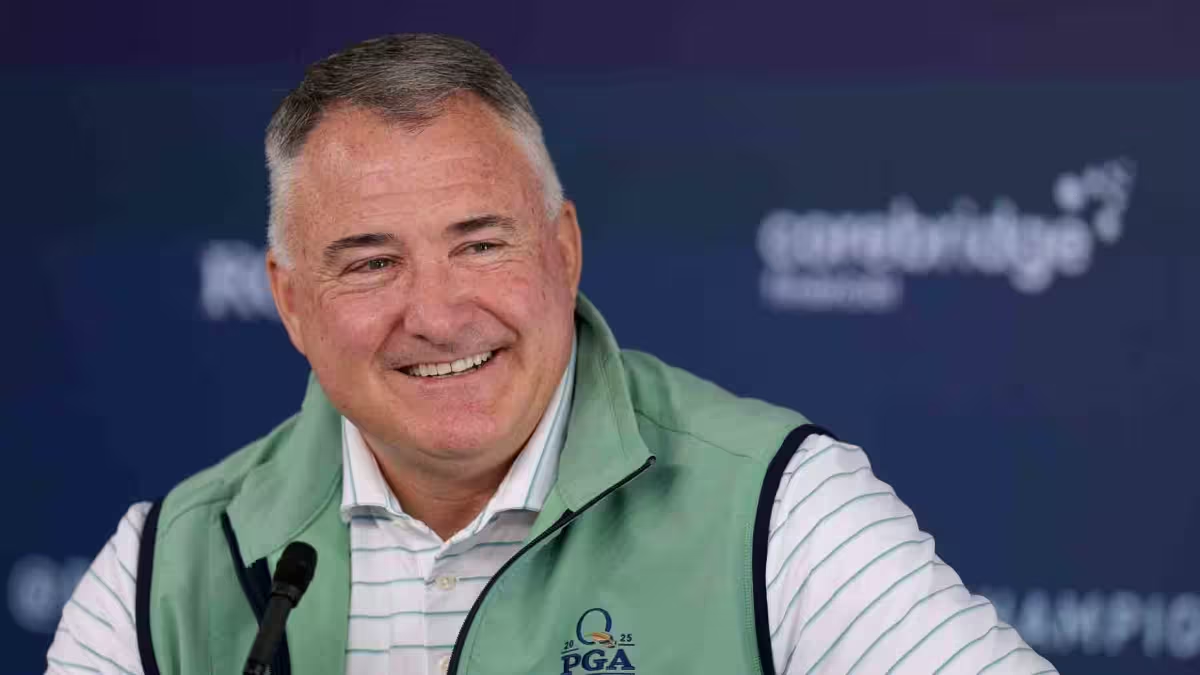
The PGA Tour is planning a substantial overhaul. Earlier this year, chief executive Brian Rolapp unveiled proposals that include promotion and relegation between tiers and more signature events with expanded fields of 120 players and 36-hole cuts. McIlroy acknowledged the arithmetic: “Does it mean it makes it harder for myself to win the FedExCup or whatever the season-long title race is going to be called? Absolutely. But I'm OK with that because it brings balance to my life and lets me enjoy things outside of the game.”


That admission is the friction at the center of his approach. By prioritizing balance over a full schedule, McIlroy accepts a reduced chance at season-long points races even as the Tour moves toward formats that reward playing more weeks and hitting every signature event. How that trade-off plays out matters because it shapes whether one of golf's biggest stars competes for — and can reasonably win — whatever crown replaces the FedExCup.
Still, McIlroy said there are certain tournaments he will chase. “I would say here and Tiger's event at Riviera, they're the two that I would love to win,” he said, naming the Memorial at Muirfield Village and the Genesis Invitational as events that carry personal weight. His best finish in 13 appearances at Muirfield Village was a tie for fourth in 2016; he has also won at Bay Hill, though, as he put it, “I've been lucky enough to win at Bay Hill, but not while Arnold [Palmer] was alive. So I always thought it would be cool to win here and take that little walk up the hill off the 18th green and shake Jack's hand.”
That reference to Jack Nicklaus underlines another throughline: McIlroy's choices are not all strategic calculus. “Also, Jack and I share a nice history. We've known each other now for nearly 20 years, or I've known him for nearly 20 years. He's been nothing but great to me and my family. So this is certainly one I would love to get done,” he said, tying personal relationships to his tournament priorities.
As the US Open looms at Shinnecock Hills later this month, McIlroy spent time on the site earlier this week scouting the setup. He missed the cut there the last time it hosted the championship in 2018, and he came away noting changes: “The fairways are very generous. They're more generous than they were in 2018 but the first cut of rough is five inches long.”
McIlroy leaves little doubt he will continue to pick and choose while still targeting the game’s most prestigious weeks. What he has not said — and what will decide whether he remains a perennial contender for season-long honors — is how many of the Tour's new signature events he will enter once the proposals take effect. With Memorial this week and the US Open ahead, the question is the most consequential one left unanswered: which of the Tour’s biggest, most point-rich weeks will Rory McIlroy actually play?



