



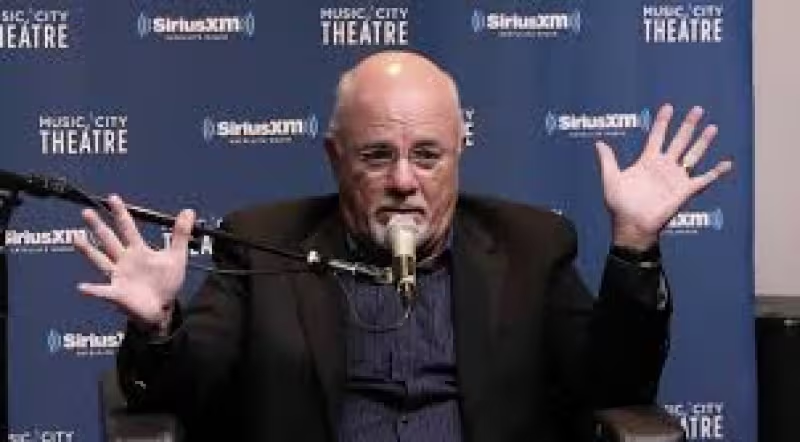
"During COVID we had our 401(k)s, our retirement accounts, and the stock market took a dive and we went down like $26,000 in a week and we got nervous," Donna, 71, told The Ramsey Show, explaining why she and her 84-year-old husband pulled money out of retirement accounts during the pandemic.
Donna said they sold because "we don't have time to recover," and that they later re-entered the market — only to panic-sell again. On air, Dave Ramsey framed the consequence bluntly: "Your $200 would be $400 if you'd have left it alone."

The numbers underline the point. Donna said her retirement holdings were roughly $190,000 when COVID struck and fell by about $26,000 in a week. Ramsey told her the round figure of $200,000 would have doubled to $400,000 had it remained invested and caught the rebound he says followed the drop.
Jade Warshaw, also on the show, pushed the practical math: she said that after Donna’s initial plunge the market recovered in about 50 days and that by taking the money out Donna "just locked in that loss. You 100% lost the $26,000." Ramsey added that Donna missed outsized returns after exiting, saying, "It went up 25% three years in a row and you missed that," and that 97% of all five-year stock market periods are profitable.
Ramsey used larger market history to illustrate the risk of timing exits. He referenced the 2008 financial crisis — when the Dow Jones, he said, fell from about 13,000 to 6,500 — and argued that those crashes and the COVID slide recovered, noting the Dow is now 36,000 since 2008. The implication for Donna: short, sharp declines often precede quick recoveries that erase paper losses for investors who stay put.


The friction in Donna’s case is straightforward and familiar: her account was the sort of diversified retirement holding that would likely have recovered, but she and her husband believed they could not wait. That belief turned a temporary paper loss into a realized shortfall — a $26,000 cash loss she cannot retroactively undo.
Ramsey did not chastise abstract behavior; he gave a specific recommendation. He told Donna to move the proceeds into a high-yield savings account and added a personal admonition about temperament: "You do not need to be investing in the stock market because you don't have the backbone to stand the volatility."
The concrete lesson Ramsey and Warshaw delivered on air was direct: panic-selling at market lows locks in losses, and missing the recovery years can erase the compounding that turns a nest egg into substantially more. They attributed Donna’s outcome to mistimed selling followed by missed years of 25% gains.
What remains unanswered is equally material. The show did not say what Donna and her husband ultimately did with their savings after the on-air advice, nor does it disclose how much retirement income or savings they retain after selling twice. Those are the facts that determine whether the advice — move to cash and accept steadier returns — will preserve the rest of their retirement or simply shift risk to a different place.
For readers, the sharp takeaways are immediate: a sudden 30% drawdown or a one-week $26,000 paper loss can vanish if investors hold, and panic-selling converts that paper into permanent shortfall; whether Donna follows Ramsey’s cash recommendation will be the decisive next chapter for her finances.



