



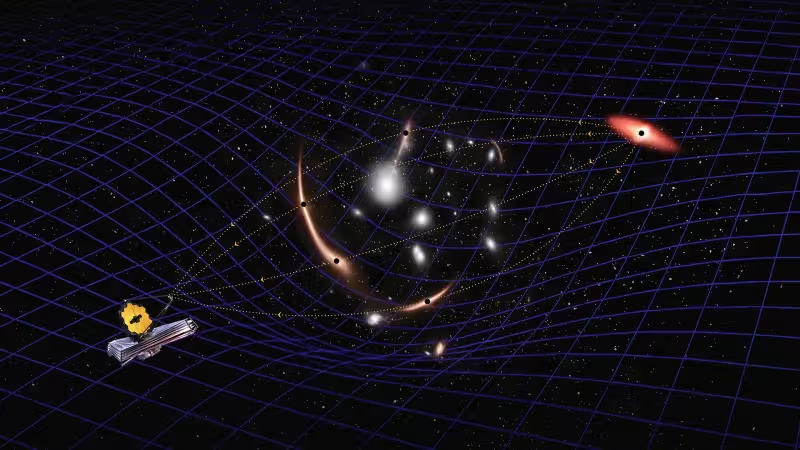
The James Webb Space Telescope has found the most distant dormant black hole known, hiding in the galaxy MRG-M0138 more than 10 billion light-years from Earth. The object, reported Thursday, June 4, in Science, is the latest evidence that black holes were already shaping galaxies early in the universe’s 13.8-billion-year history.
What makes the find stand out is not just the distance. The newly analyzed black hole pushes the previous record for a dormant object back by a factor of 15, giving researchers a far earlier place to study how black holes grow, exhaust their fuel and go quiet.

Dormant means the black hole is not acting like an active quasar now. But scientists suspect MRG-M0138 once hosted one that grew quickly and hurled out much of the gas the galaxy needed to make new stars. In that scenario, the black hole did not simply stop feeding; it helped empty the pantry.
That matters because the galaxy sits in a period when the universe was still young enough for its first generations of big galaxies and black holes to be taking shape. By finding a dormant black hole at this distance, JWST gives astronomers a rare chance to compare what happened when the engine was still running with what remained after it shut down.
Andrew Newman, one of the researchers involved, said the stars in MRG-M0138 are ancient, but star formation shut down much later in other galaxies the team has observed with JWST. He described them as cinders that can be studied to learn what put out the fire. In particular, he said, the team is looking for signs of gas blown out of galaxies by a black hole more active than the one now seen in MRG-M0138.
The friction in the finding is that the shutdown story is still partly inferred. Scientists suspect a rapidly growing quasar once powered the galaxy into a brief, violent phase, but the black hole now appears quiet and dormant. What exactly drained the fuel and ended star birth remains the open question.
Researchers examined four other distant, gravitationally lensed galaxies with JWST last year, and analysis of that larger dataset is still underway. MRG-M0138 is the standout for now, but the broader sample may show whether this kind of blowout-and-shutdown path was common in the early universe or just an especially dramatic case.
For now, the record is clear: JWST has identified the farthest dormant black hole yet, and it gives astronomers a fresh way to read the scar tissue left behind when a galaxy’s central engine burns itself out.



