"I was here when the team first came [to Raleigh]," Bates Battaglia said, watching a tide of Hurricanes jerseys and painted faces flow through Glenwood South as Game 2 unfolded at Lenovo Center. Battaglia owns two bars in the neighborhood, and both drew fans from all over the city on a night when the playoff frenzy refused to stay inside the building.
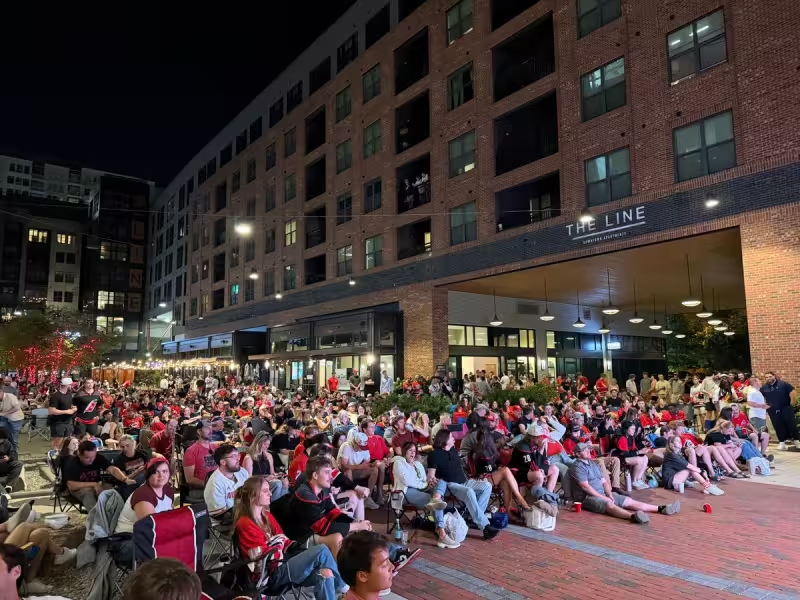
The scale was immediate: a crowd of hundreds gathered at Moore Square and another of hundreds at Smoky Hollow for public watch parties, and dozens more squeezed into downtown bars where televisions and shoulder room were at a premium. Battaglia's two establishments were among those packed, staff stretched thin as patrons cheered every whistle and skated toward one another between plays.

"To see the fans go into the stadium and see how loud they are. It's the loudest arena in the league," Battaglia said, nodding to the roar inside Lenovo Center and the echo it sent into the streets. "We're a hockey town," he added, short and plain, the kind of summary that left no doubt about why people chose downtown over the drive home.
Fans had options beyond the arena: Moore Square and Smoky Hollow served as magnets for the crowd, with coordinated screens and DJs turning the plazas into temporary fan zones. Other bars across downtown filled up fast. The visible result was a playoff night that felt citywide, not just seat-by-seat inside the arena.
Battaglia anchored the scene with memory and continuity. He recalled the last time the Hurricanes reached the Stanley Cup Final in 2006. "What is really cool is that in 2006, I had Lucky B's. I saw it the first time around with everybody in the finals. To see it 20 years later, another shot at it, it's really cool," he said, folding two decades of local sports life into a single breath. The comparison gave the evening a historical weight: this was not just a crowd, but a recurrence of a civic ritual.
The visibility of the fans outside the arena sharpened a simple friction: the electricity of Game 2 was concentrated as much on sidewalks and in barrooms as in the seats at Lenovo Center. That split matters practically—tickets and seats are finite, but plazas and pubs expand to hold a city. It also matters for who claims the night. For business owners like Battaglia, that diffusion meant fuller bars and a longer night of service; for fans it meant companionship when entry to the arena was impossible or unwanted.
Battaglia framed the choice plainly: some fans went inside and amplified the arena; hundreds more chose shared screens and shared space in Moore Square, Smoky Hollow and the bars lining Fayetteville Street. The result was simultaneous celebration—inside the arena's concrete bowl and outside under the streetlights. The dual scenes reinforced his declaration: "We're a hockey town."
Practical details threaded the evening. Local performers and pregame moments were part of the lead-up at Lenovo Center (Adam Lee Decker to Sing National Anthem Before Hurricanes' Game 2 at Lenovo Center — and the game itself was carried live from the arena for citywide consumption (Golden Knights Vs Hurricanes: Game 2 Live from Lenovo Center in Raleigh — Still, Battaglia pointed back to the bars as the living room for many fans on Game 2.
He has already planned for the nights ahead: Battaglia said Teets and Lucky B's will continue to host events for the upcoming games. That decision turns an observation into a commitment—the same neighborhoods that swelled for Game 2 will have structured places to gather again. What remains uncounted is the total number who watched across the many downtown venues; officials and proprietors alike described hundreds in key spots, but a citywide tally was not available as the night wound down.
The night closed with a clear sense of continuity and purpose: a local bar owner who remembers 2006 now preparing his two Glenwood South venues for more playoff nights, a stadium that thunders inside and a downtown that answers back on the street. For Battaglia and the fans who stayed out late, the next games are no longer potential—they are scheduled opportunities to meet again.