



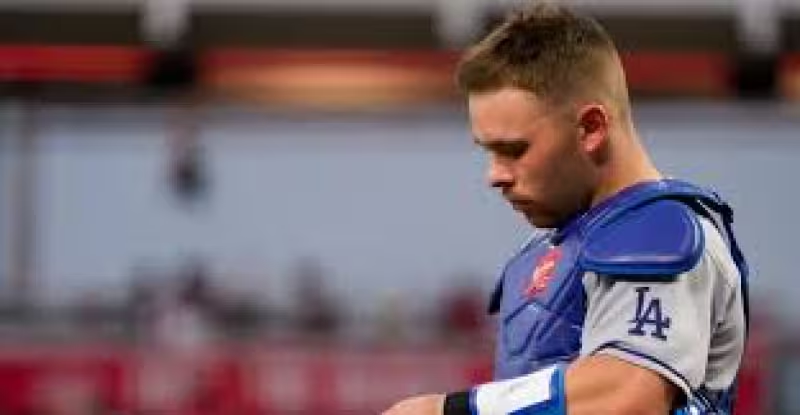
Last month the Dodgers began running Dalton Rushing through bullpen sessions off their Trajekt Arc pitching machine to teach him the strike zone and tighten his Automated Ball-Strike (ABS) challenge decisions.
The move produced an immediate sign of payoff on Sunday: Rushing successfully overturned two calls in Yoshinobu Yamamoto’s start — first a sinker on Kyle Schwarber that became strike three, then a backdoor cutter to Bryce Harper seven pitches later. Those two wins lifted a small-sample signal around a player who has won five of his 11 ABS challenges, a 45 percent success rate entering Tuesday.

The Trajekt Arc setup is built to reproduce release points and deliveries and to show specific pitch characteristics. The Dodgers have used it with hitters; last month they began putting catchers behind the machine so the reps more closely mimic the look of real pitches. In a session last Friday before a game against the Phillies, the club ran Justin Wrobleski as the simulated starter. Every pitch produced a packet of data — where Rushing caught it, where the pitch sat in the zone and whether it should trigger an ABS challenge — information the staff can review with him afterward.

That procedural detail matters because Rushing’s ABS numbers are a practical weakness. He was called up in May 2025 after two seasons working with ABS in the minors (2024 and 2025) and now backs up Will Smith; Smith entered Tuesday with a 67 percent success rate and 30 successful challenges, tied for fourth among catchers. By contrast, Rushing’s 45 percent mark sits below the league catcher average of 58 percent. Dodgers general manager Brandon Gomes has argued the work is about building a mental model — repeated reps and video-backed cues that help a catcher say, in real time, “that looks out.”
On the field, the technology’s benefit is both obvious and limited. Trajekt Arc gives repeatable looks that human pitchers cannot always provide; it accelerates pattern recognition by isolating release points and pitch shape. But the ABS decision is not purely visual: framing, pitcher consistency, and the scoreboard all push and pull an umpire’s call and a catcher’s willingness to challenge. The Dodgers are one of only a few clubs applying Trajekt Arc to catcher training, and the club’s pitching coach has framed the tool as a margin-of-error play for young catchers — a way to reduce rookie stress and bring them closer to the speed of the majors without burning innings or confidence.
The friction is simple and unavoidable: Rushing’s 45 percent success rate is well under the 58 percent league average. Two successful challenges in one start are encouraging, but five of 11 is small sample evidence. The Trajekt Arc delivers richer feedback than a typical bullpen, but it does not yet answer whether those reps will translate into a sustained uplift in challenge accuracy when the stakes are live and pitchers do not come from a machine.
The single most consequential unanswered question is whether repeated Trajekt Arc reps will push Rushing’s ABS success closer to league norms and toward Smith’s level. The Dodgers have shown they are willing to borrow a hitter’s prep tool for catchers, and Sunday’s results give the club reason to keep testing it. The outcome that will matter is straightforward: if Rushing converts a higher share of his next 20 to 30 challenges, the experiment becomes a model other clubs might copy; if he does not, the work on margins remains an interesting supplement rather than a solution.



