



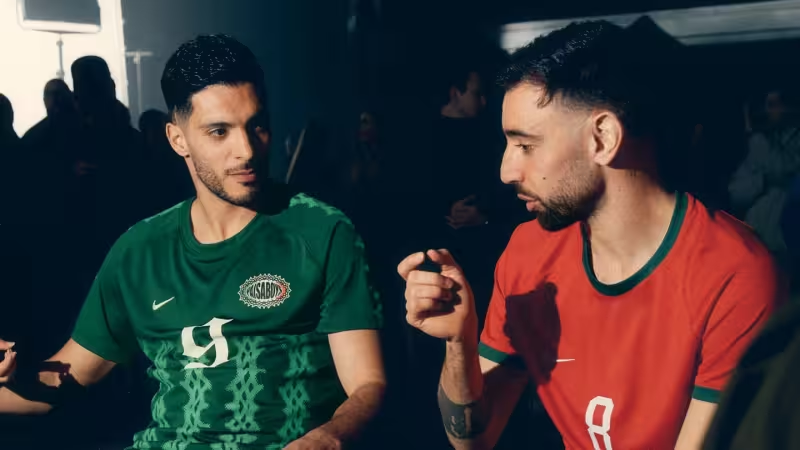
Raúl Jiménez appears alongside Jorge Campos in Nike’s new Rip the Script campaign, an image that frames the striker’s return from a life-threatening injury as part of a longer Mexican tradition of players who ignored expectations.
For Jiménez the photograph lands at a charged moment: he returned to professional football after a November 2020 head collision at Molineux that fractured his skull and, doctors warned at the time, carried a risk to his life. Now the third-highest scorer in Mexico’s history, Jiménez is eight goals shy of the national mark and preparing for his fourth World Cup, hoping to start and finally score at the tournament.

Camilo Andrade, Nike’s Global Vice President & General Manager Soccer, explained the pairing as deliberate. He described Jorge Campos as the player who “broke the script first,” and called Jiménez a modern protagonist in the same vein — singled out for the style of football he plays and the passion that links generations since the World Cup of 1986.
The image leans on clear cultural weight: Campos was unusual even in 1994, a goalkeeper who pressed high, scored goals and famously wore uniforms he made himself. Nike has long treated its soccer commercials as cultural events; placing Campos and Jiménez in the same frame ties a 1994 icon to a contemporary comeback story and casts both as rulebreakers.
That framing is the campaign’s strongest claim. Campos broke positional expectations by behaving like an attacker, and Jiménez’s story is now legible in similar terms — not only as a goalscorer but as a player who returned from a nearly fatal injury to resume top-level football. Camilo Andrade suggested the pairing was meant to show continuity: a Mexican lineage of players who redefined roles.
The campaign also exposes a tactical friction that follows Jiménez onto the pitch. He is described as a striker at a time when many coaches and analysts celebrate false nines and fluid front lines; the modern game often prizes movement and hybrid roles over a fixed number nine. Yet Nike’s choice to spotlight Jiménez treats him as an archetype — a center forward with a story whose drama is its clarity.
That contradiction is not accidental. It is one of the reasons the image positions Jiménez next to Campos: both are memorable because they did something simple and unexpected within their context — Campos by turning his goalkeeping into offense, Jiménez by surviving a catastrophic head injury and returning to score for his country. The photograph asks viewers to read both acts as disruptions of the script.
What the campaign does not answer is when viewers will see the full ad, or whether Nike plans a global rollout. The image has been released; the timing and scale of the wider campaign remain unconfirmed, leaving a gap between the claim (a visual linkage of generations) and the delivery (when that story will be told in motion to a broad audience).
For Jiménez the practical next step is unchanged: preparation for the World Cup. Nike has set an image that frames him as part of a lineage of Mexican rule-breakers — but the measure of that framing will arrive on the field. If he starts for Mexico and adds goals in Qatar, the ad will feel prescient; if he does not, the photograph will read more like aspiration than proof. Either way, fans still do not know when they will see the campaign’s full version.



