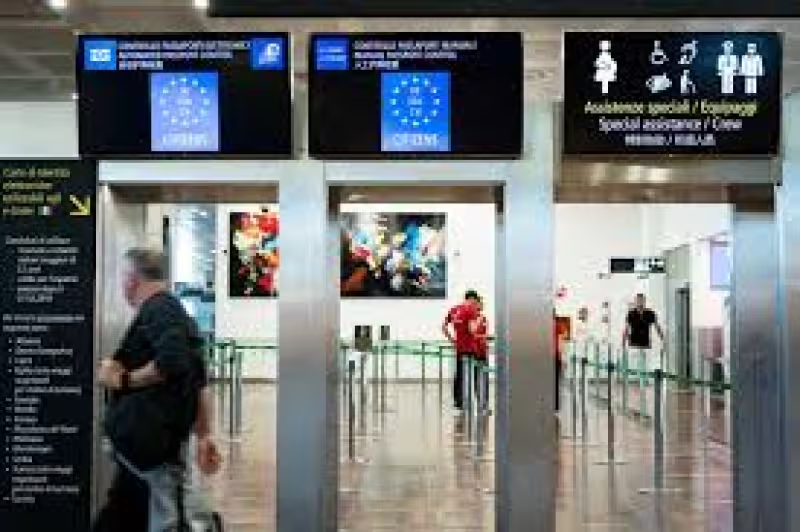
Yvonne Moynihan, Wizz Air's UK chief, told British holidaymakers on Saturday to arrive three hours before flights home via European airports because the new EU Entry‑exit System checks are producing long passport‑control queues.
Moynihan said the impact of the new biometric checks has been "fragmented across Europe" and that travellers were experiencing longer waits than expected, adding that "in these circumstances, we are advising three hours." She urged passengers taking connecting flights to allow extra time and to pack a portable charger and water because there can be delays between landing and getting through border control.

The warning follows an ACI Europe survey of 45 airports across 20 EU states on 26 May that found queues of up to 3.5 hours at peak traffic times. Airports involved in the poll reported that locations which had not previously seen excessive waits were now doing so, and ACI Europe said the situation was deteriorating.
That buildup has had practical consequences: some passengers have missed return or connecting flights because of long waits at passport control. The Entry‑exit System requires travellers to register fingerprints and replaces passport stamps with digital registration, a change airlines and airport managers say is reshaping the time passengers need to allow for border formalities.
European authorities offer a different view. A European Commission spokesperson said the system was working well at "almost all border crossing points" and that registering the required information usually takes about a minute. Commission figures show that since October almost 80 million entries and exits have been recorded and 35,000 refusals of entry logged.
The picture on the ground is mixed. Moynihan pointed to "usual hotspots such as Spain, Portugal, France" as places where queues have been long, yet she also said she personally encountered no queues on a half‑term trip to Mallorca. Airports have responded in different ways: Greece has effectively suspended biometric checks for British citizens to avoid summer disruption, and last week French police temporarily suspended checks at the port of Dover during sweltering, congested conditions.
Airports’ trade body urged passengers to follow the check‑in and arrival guidance set out by their airline, while Moynihan’s instruction goes further for UK travellers returning via Europe: plan on three hours between arrival at the airport and departure. She also warned those making connections to allow a "number of hours between flights" to cover the possibility of long border queues.
The EU Entry‑exit System has been rolled out gradually since October and is meant to be fully in use at Schengen borders, including airports, from 10 April. That timetable heightens the immediate relevance of Moynihan’s advice: airlines can warn customers, but the variation in how EES is being applied — and occasional suspensions or partial suspensions at specific borders — leaves a gap in which individual airports may still produce severe delays.
For British travellers the practical conclusion is clear: follow Moynihan’s guidance and build extra time into return journeys. The Commission says EES functions smoothly at almost all crossings, but airport surveys and reports of multi‑hour queues show the system is already creating disruption at busy moments — and it remains uncertain which airports will produce the longest waits as the rollout continues.