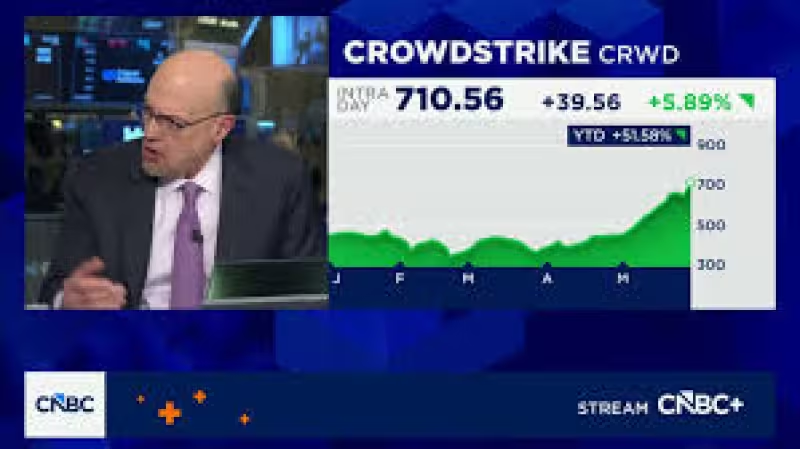
Shares of CrowdStrike jumped 4.2% in the afternoon session today after Snowflake reported an impressive Q1 and CrowdStrike announced a collaboration with insurers Coalition, Liberty Mutual and Lockton to help organisations quantify and mitigate financial exposure from frontier AI cyber risks.
The initial pop cooled later in the day, with shares settling at $669.67 — up 3.6% from the previous close — leaving the stock trading close to its 52-week high of $671.55 reached in May 2026.

The move capped a volatile stretch for the security software maker: CrowdStrike has recorded 15 moves greater than 5% over the last year and is up 47.6% since the start of the year. An investor who put $1,000 into CrowdStrike five years ago would now hold roughly $3,014, underscoring how sharply the stock has climbed.
Analysts have been revising targets in recent days. BTIG raised its price target to $764 on May 26, and Benchmark and Wedbush moved theirs to $700 on May 27, signalling confidence from parts of Wall Street even as the stock swings widely.
For traders watching crwd stock, the rally also followed a run of intraday strength: the cybersecurity sector had been on a record-breaking run with eight consecutive intraday highs at CRWD, a streak that helped set the stage for today’s response to Snowflake and the insurer announcement.

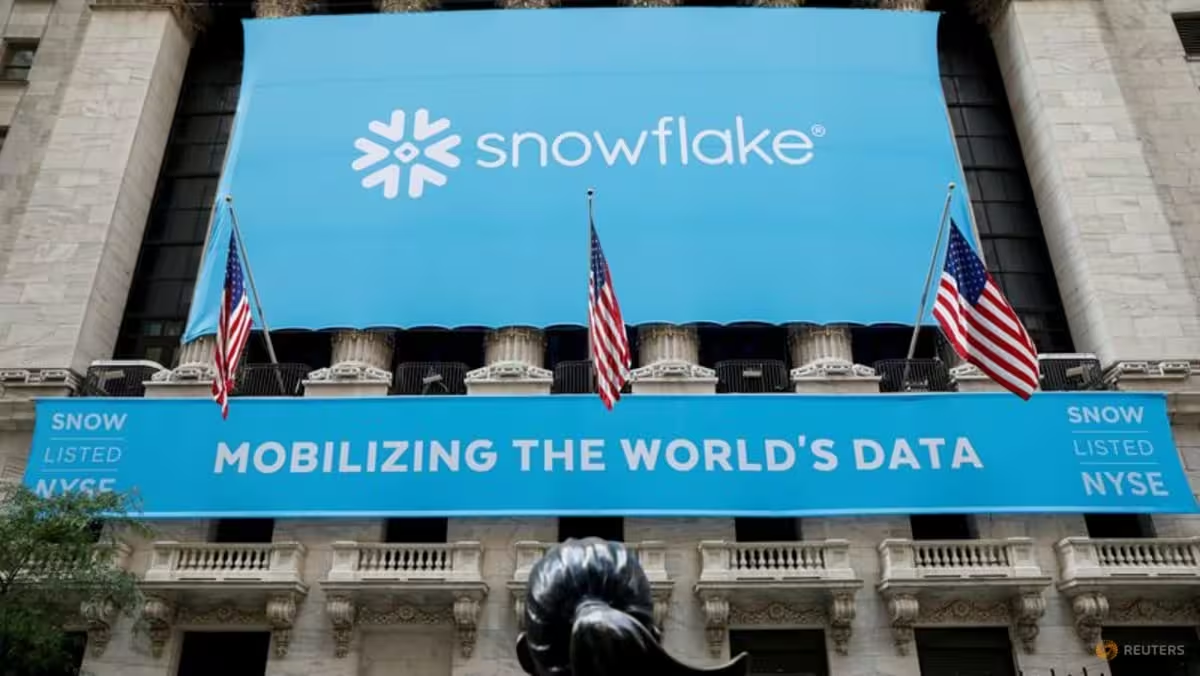
Market commentators treated the gains as evidence that the so‑called 'SaaSpocalypse' selloff may have been overstated for platforms at the centre of AI workflows. Morgan Stanley, in a pre-earnings note, had told clients that security budgets are not the line item CFOs are cutting, and many investors see CrowdStrike as a direct beneficiary of that dynamic.
The rally, however, sits against a puzzling backdrop. Just one day earlier CrowdStrike shares plunged about 4% after peer Zscaler reported fiscal Q3 2026 results — even though Zscaler posted a 25% jump in revenue to $850.5 million, an adjusted EPS of $1.08 that beat consensus by 7%, and a record non-GAAP operating margin of 23%.
That dissonance—the market punishing a peer despite strong fundamentals, then rewarding CrowdStrike after a separate catalyst—highlights the uneven read investors have on near-term demand for cybersecurity services. The insurer collaboration adds a concrete commercial avenue for CrowdStrike to help customers and underwriters model novel AI-related threats, but how much that will move the revenue needle remains to be seen.
Today’s pattern — a sharp intraday jump tied to external tech results and a strategic partnership, followed by a partial retreat to trade just below recent highs — suggests investors are still parsing mixed signals. The price-target bumps from BTIG, Benchmark and Wedbush, and the stock’s strong year-to-date performance, indicate conviction among some analysts; the frequent double-digit swings and the prior day’s 4% drop show the market’s discomfort with binary outcomes.
Bottom line: investors are betting the worst of the SaaS-driven selloff is behind them and that security vendors like CrowdStrike will keep benefiting as companies prioritize protection around emerging AI risks. Whether that confidence holds will depend on whether forthcoming earnings and commercial traction from initiatives such as the insurer collaboration translate into sustained revenue growth rather than short-lived sentiment-driven jumps.