



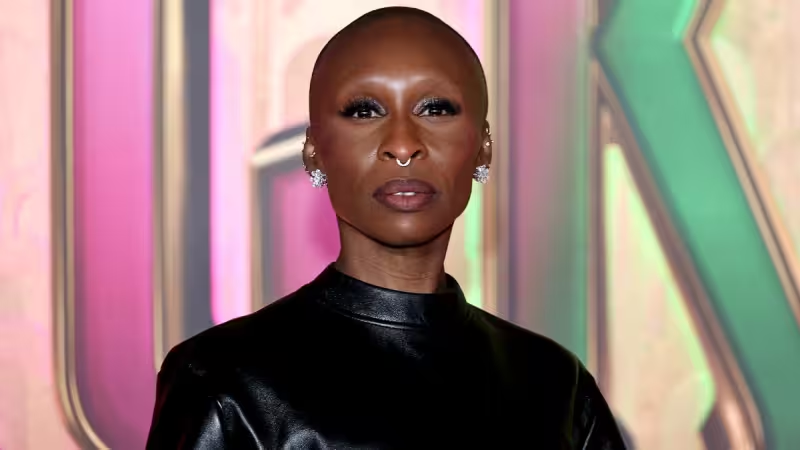
At the Singapore premiere of Wicked: For Good, Johnson Wen jumped a barrier at Universal Studios Singapore and rushed toward Ariana Grande and Cynthia Erivo, grabbing Grande before others could react.
Cynthia Erivo said afterward that she and Grande were terrified. "In that moment, we were all terrified," she told reporters, and described moving in because "Nobody moved. Nobody moved. So I moved because my brain went, ‘Get him away! Get him out of here!’"

The man who grabbed Grande was later sentenced to nine days in jail. Social media replayed the footage on loop, and reaction ranged from shock to cynical jokes — including suggestions that Erivo had become Grande’s bodyguard.
Erivo said that public response cut deeper than the jokes. She described the backlash as evidence of "the insidious nature of how we view Black women," saying plainly, "I just felt like my humanity had been bastardised." She told interviewers that she had been reluctant to campaign for Oscars for Wicked: For Good because of the reaction to the red-carpet incident.
The stakes here were not only personal. Erivo and Grande were cast in Wicked in November 2021 and spent years promoting the property through global campaigns. The first Wicked film took $765m worldwide and won two Oscars after earning 10 nominations; Wicked: For Good was released in November 2025, took $541m worldwide and received no Oscar nominations. That gap — box office heft on one hand, awards silence on the other — framed how moments like the Singapore rush were read in public.
The tension in the story is simple but sharp: Erivo says she acted instinctively to pull a fan away from a colleague and friend, and the internet turned that instant into something else. The social-media refrain that cast her as a hired protector flattened the action into a punchline and, Erivo said, forced her to question whether being visible on a red carpet was worth the personal cost. "I felt like something I did instinctively had been made to be something that it simply was not because of the way people see women who look like me, and because of the assumptions that are made, and I just didn’t want to be a part of that, really and truly," she said.
Despite the shock and the online chatter, Erivo and Grande remain close. The two, who were cast together four years before the sequel’s release, still text almost every day, Erivo said — a private throughline behind a very public moment.
The legal outcome was brief: Wen received nine days in jail after the incident. The public fallout has been longer. For Erivo it has been both a personal affront and a professional complication: she has said the red-carpet reaction made her reluctant to push for awards attention for Wicked: For Good, and the film ultimately received no Academy nominations.
What happens next is not conjecture; it is visible in Erivo’s own words and decisions. The Singapore episode did not end with a court date or a viral clip. It changed how one of the film’s lead actors wants to be seen and how she chooses to use her visibility. The instinct that drew her into that moment saved Ariana Grande from a closer confrontation, and the public response to that instinct hardened Erivo’s resolve to step away from certain publicity rituals rather than have her actions misread. That is the fallout: an instinctive rescue, a short jail sentence for the assailant and a rarely acknowledged cost — the way a single instant on a red carpet can reshape an awards campaign and a performer’s willingness to put herself forward.



