



A week before the release of Inferno, attendees in a Barcelona arthouse cinema watched the album played back in its entirety during a listening session marked by the group's familiar symbols: Boards Of Canada's hexagonal logo projected on the walls and spun on circular screens set into the ceiling.
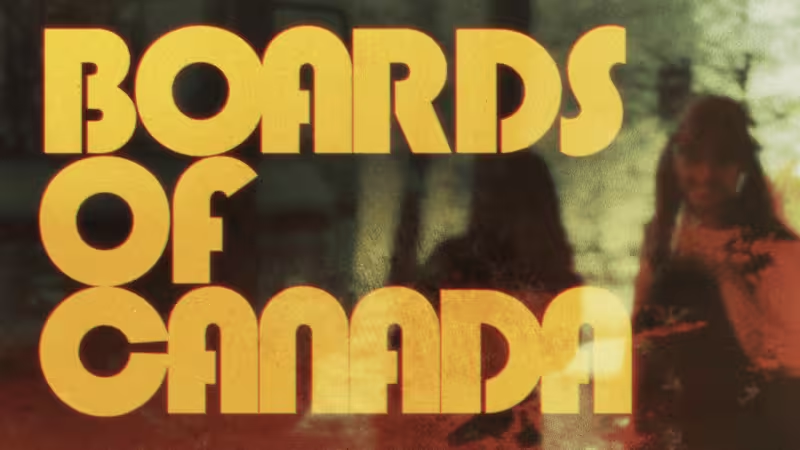
Marcus Eoin, one half of the cryptic Scottish duo, has long explained the visual through-line. In 2002 he told NME, "The hexagon theme represents that whole idea of being able to see reality for what it is, the raw maths or patterns that make everything," and he has added more broadly, "We’ve always been interested in science and maths." Those remarks now read like a map for Inferno's rollout: early April 2026 saw mysterious VHS tapes mailed to a handful of recipients — each marked with a pattern of seven hexagons and degraded visuals and audio — and garish posters appeared across London, New York, Los Angeles and Tokyo.

The campaign led to Warp Records announcing the imminent arrival of Inferno later that month, a fifth LP that closes a 13-year radio silence since the duo's previous record. Teasers landed in music feeds as well: a short clip titled Tape 05 was later confirmed as the album cut Deep Time, and two tracks — Introit and Prophecy At 1420 MHz — were issued after the teaser. Listening sessions for Inferno were not limited to cinemas; theaters, auditoriums, churches and record stores around the world hosted full-album playbacks, framing the release as collective ritual rather than a standard album launch.
The music itself leans on what listeners recognize. Inferno is structured as a long-form listening experience and, on its deluxe edition, a single-track continuous mix presents the full album as one uninterrupted piece. Sonically it alternates between punchy, rhythm-heavy chuggers and gauzy, nostalgia-soaked interludes; thematically it layers mysterious hints at a broader investigation of religious faith, human biology and existential doubt. Those elements make the release feel both like a return and an escalation.
The weight of the pattern is hard to understate. Boards of Canada first appeared in public in 1987 with Catalog 3, a super-limited cassette on their Music70 imprint, and through the late 1980s and early 1990s tracks such as Acid Memories, Play By Numbers and Hooper Bay were circulated privately to friends and family. Their 1998 album Music Has the Right to Children established an esoteric style the duo have not significantly altered since, and a best-known song—Turquoise Hexagon Sun—along with the Hexagon Sun studio/collective, has long anchored their lore.
That continuity is the story's tension. Inferno's publicity — mailed VHS, citywide posters and staged screenings in consecrated spaces — points to a band interested in ritual and mystery. Yet musically the duo remain recognizable, sticking to the architecture they built in 1998 even as they push into weightier themes. Marcus Eoin framed the paradox himself when he said, "Sometimes music or art or drugs can pull back the curtain for you and reveal the Wizard of Oz, so to speak, busy pushing the levers and pressing buttons," adding later, "That’s what maths is, the wizard." The promotional sleight-of-hand aims to make listeners peer behind the curtain without surrendering the comfort of the sound that conjured the curtain in the first place.
Inferno asks its audience to sit with that glare. The album is not a reinvention; it is an intensification: long-form sequencing, a continuous deluxe mix, and lyrical nods toward faith and biology all deepen the duo's preoccupations rather than abandon them. For a band that began with a super-limited cassette in 1987 and spent 13 years away from the public ear, the record delivers what their listeners have long expected — a painstakingly staged, thematically dense experience that expands the hexagon's scope without breaking it.



