



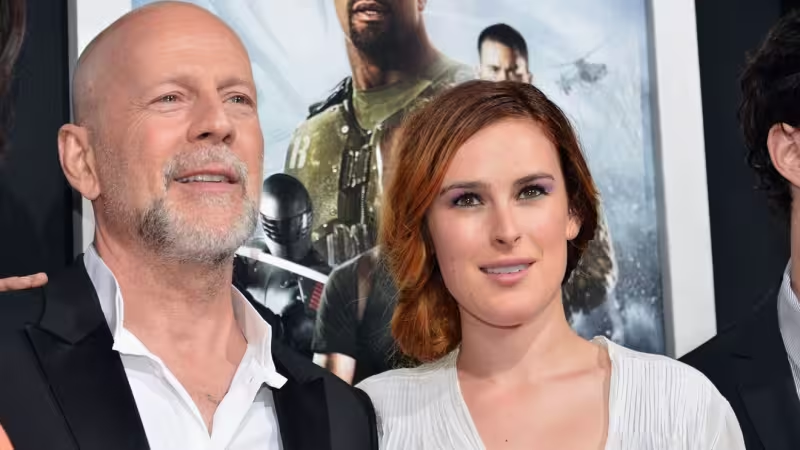
Rumer Willis said Monday on The Inside Edit podcast that her father, Bruce Willis, has developed a new gentleness during his battle with dementia: "There’s a sweetness. He’s always been this kind of macho dude and there’s like a - fragile is not the right word but - just a tenderness that maybe being Bruce Willis might not have allowed him in a certain way."
Those words came from the actor’s eldest daughter three years after the family first disclosed health troubles. The family announced in 2022 that Bruce Willis was retiring from acting following an aphasia diagnosis in March 2022, and they later revealed in February 2023 that he was living with frontotemporal dementia. The family said then, "While this is painful, it is a relief to finally have a clear diagnosis," and that "for people under 60, FTD is the most common form of dementia, and because getting the diagnosis can take years, FTD is likely much more prevalent than we know."

Rumer Willis framed her comments around the practical smallness of daily visits and the persistent emotional connection she still finds in them. "I’m so grateful I get to go see him. Even though it’s different now, I’m so grateful," she said, adding later, "I’m so happy and grateful that I still get to go and hug him. I’m so grateful that when I go over there, and I give him a hug, whether he recognizes me or not, that he can feel the love I’ve given him, and I can feel it back from him. That I still see a spark of him, and he can feel the love that I’m giving. So that feels really nice."
Those moments are measured against sharper memories. In November, Rumer Willis acknowledged that her father does not always recognize her anymore. She described visiting with a family member named Louetta: "I just feel grateful that I get to go over there with Louetta and we get to spend time with him, and I get to feel the love that he has for me, and that I can love him and be with him."


The weight of what she described—intimate exchanges that survive significant cognitive loss—matters because the family has pushed the public conversation beyond a star’s retirement. Their statement about frontotemporal dementia was posted on the Association for Frontotemporal Degeneration’s website, where they stressed both the pain of the condition and the urgency of earlier diagnosis. Rumer has heard from others affected by the disease: "My uncle had FTD. My dad had this," she said, and added that many people have told her their relatives had frontotemporal dementia.
There is a tension at the heart of Rumer’s account. The public image of Bruce Willis—the "macho" action star known for Die Hard—clashes with the private softness she now sees. That shift is not a tidy redemption; it comes with losses she does not gloss over. She said candidly on the podcast, "I had no idea" and called some of the experience "It’s wild to me," admitting that the change is both surprising and familiar, given her family's past exposure to the illness.
Rumer’s reflections also reinforce the family’s stated priority: connection and awareness. In their announcement about the diagnosis, they wrote they "would want to respond by bringing global attention and a connectedness with those who are also dealing with this debilitating disease and how it impacts so many individuals and their families." Her descriptions of hugs that register one-way recognition and of tenderness that was once hidden are part of that effort—personal testimony aimed at making a clinical diagnosis feel human and immediate.
The clearest result of Rumer Willis’s remarks is that they change how people might picture Bruce Willis today. They do not revise his public career; they reframe his private life. Her conclusion is direct: amid the loss of memory and the altered exchanges of family life, there is a gentler man who still responds to love. That reframing is itself consequential—because the family has asked for attention to frontotemporal dementia, these private moments Rumer describes become part of a public case for earlier diagnosis and greater awareness.



