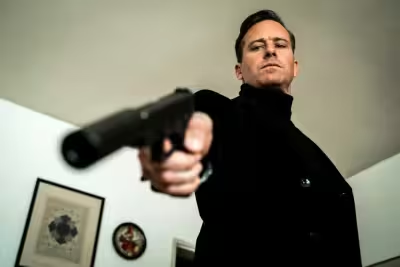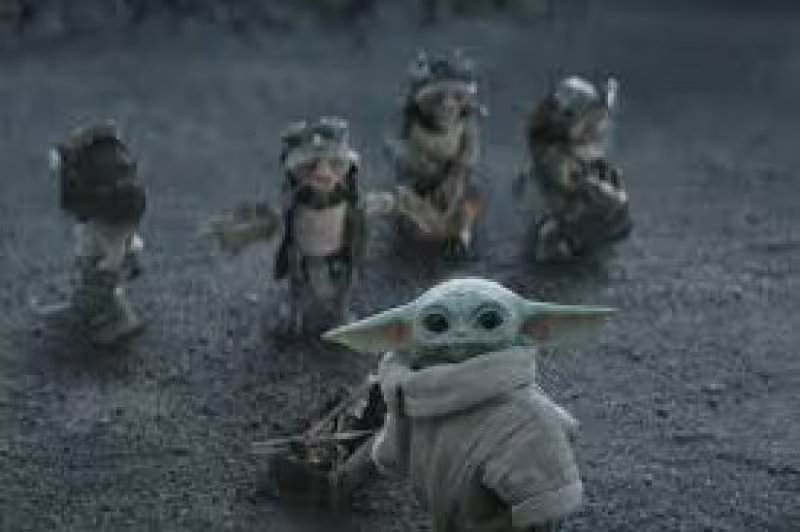
The Mandalorian and Grogu opens with a man in a crisp Imperial uniform giving a speech from the head of a conference table — and it is the first Star Wars movie in seven years. That sequence lands at the top of a franchise that has been testing two very different paths: the streaming, adult drama of andor and the family-friendly, adventure-focused Mando universe now on the big screen.
Tony Gilroy has lived the streaming experiment. His Andor series was greenlit when streaming was described as a Wild West, and Disney spent $650 million on two seasons of the prequel to Rogue One. The Tony Gilroy series was widely described as an intelligent, serious and gripping exploration of fascism, the nature of resistance, and genocide; it was also called the most mature title Star Wars has ever released.

The numbers matter. Rogue One — the theatrical prequel to A New Hope, to which Andor is a TV prequel — proved in 2016 that mature Star Wars could still be a blockbuster, grossing over $1 billion globally. Disney later released Solo: A Star Wars Story in 2018, and then paused before sending another Star Wars film to theaters. Now The Mandalorian and Grogu marks the studio's return after that gap.
Andor’s commercial arc was uneven at first. Season 1 started with underwhelming viewership, but the show later became the most streamed Star Wars title on Disney+ according to Nielsen, and it led among Millennials and Gen X. By contrast the Mandalorian reached different audiences: it was the top-streamed Star Wars title among Boomers and Gen Alpha, while Gen Z favored The Clone Wars, created by Dave Filoni. The article says young people like Mando and Baby Yoda.
The contrast is sharp in cost and tone. The Mandalorian and Grogu can cost just $165 million, a figure presented against the streaming-era outlay for two seasons of Andor. The Mandalorian is presented as a more adventure-focused, family-friendly franchise extension with mass-market appeal; Andor was framed as a niche, mature project expensive to make and suited to the streaming era. That split—different budgets, different audiences, different narrative aims—now plays out publicly as a movie and a streaming pedigree both claim to define the franchise's future.
There is institutional change beneath the surface. Dave Filoni, described as the new head of LucasFilm, built his reputation with The Clone Wars and the live-action Mandalorian universe, and those titles command particular demographics. Gilroy’s Andor proved that a serious, adult-oriented series could not only be made at scale but also reach a large audience on streaming, despite a slow start. Those are not mutually exclusive lessons; they are competing ones.
The tension is simple: which lesson will guide the studio now? One path favors lower-cost, high-appeal theatrical adventures that can reconnect mass audiences in cinemas. The other favors expensive streaming ambitions that reframe Star Wars as a space for mature drama and long-form resistance stories. Both are supported by recent evidence — Rogue One’s billion-dollar box office in 2016 and Andor’s later Nielsen streaming dominance — but they aim at different viewers.
The sensible conclusion from what has happened is this: Andor changed expectations about where serious Star Wars stories can live and who will watch them, but it did not displace the Mandalorian's ability to bring new audiences back to theaters. The Mandalorian and Grogu’s opening shot — an Imperial officer addressing a table — signals that LucasFilm will now run both experiments at once: a franchise that remembers Rogue One’s box office potential and a streaming arm, exemplified by andor, that proved mature storytelling can find a mass audience on a platform. That dual strategy is where the franchise is, practically and strategically, after seven years without a theatrical Star Wars film.