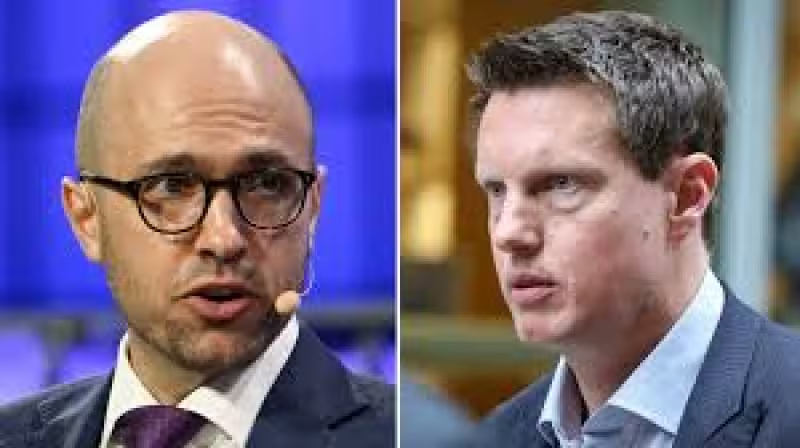
A.G. Sulzberger told a press-rights group in New York on Thursday that news organizations are bending to President Donald Trump and that CBS, under its new ownership, has already begun to change in ways that undermine basic journalistic standards.
"Under this new ownership, CBS has already altered programming, personnel, and policies in ways that align more closely with the administration’s preferences," Sulzberger said, singling out what he described as a new willingness to put the outlet’s business and access calculus ahead of independent reporting. He added that CBS was "dispensing with even the pretense of journalistic norms."

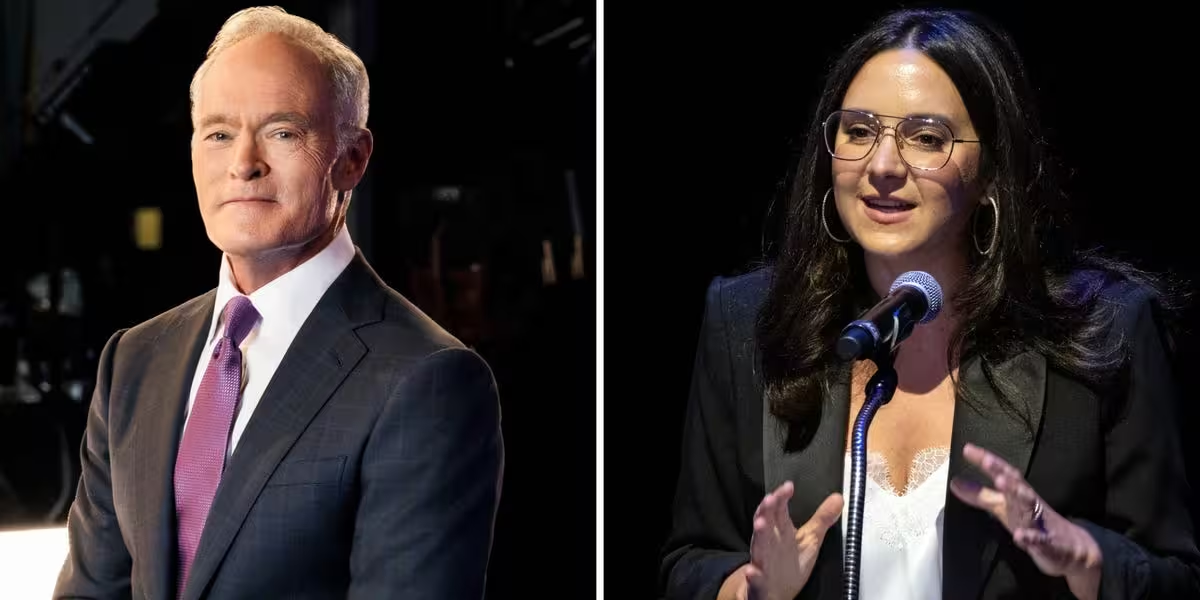
The specifics Sulzberger cited are factual and recent: CBS News is now controlled by Paramount Skydance under David Ellison, who last month hosted an intimate dinner honoring the Trump White House. Bari Weiss, installed as editor-in-chief under Ellison’s ownership, recruited Tony Dokoupil to anchor the CBS Evening News. Weiss also pulled one episode of 60 Minutes just hours before it was scheduled to air. Last July, CBS settled with Donald Trump for $16 million after he alleged that 60 Minutes had deceptively edited its 2024 interview with Kamala Harris.
Sulzberger framed those moves against a broader industry reaction to lawsuits and pressure from the White House. He noted that ABC News agreed to a $15 million settlement in 2024 in a defamation case brought by Trump, and he said several editors and executives had privately warned him that fighting back could invite retaliation. "Many of our peers argued that, given Trump’s frequent attacks on the press, this one was worth letting go. In fact, several told me directly that they feared sticking their necks out would invite retaliation," he said.

The numbers underline the stakes: seven-figure settlements, executives repositioning editorial teams and the cancellation of broadcast pieces all point to a rawer, more transactional relationship between political power and newsrooms. Sulzberger, who succeeded his father as publisher in 2018, used that arithmetic to press a legal and moral argument: "But rights are just ink on paper unless they’re exercised." He urged news organizations to defend those rights even when defeat is possible, saying, "Standing up for press freedom in court and losing is still a much healthier outcome than standing down and letting the administration simply rewrite the rules."
There is, however, an uneven response across the industry. Sulzberger said that while some peers counseled caution, others had pushed back. He credited the, The and NPR with resisting the administration’s efforts to punish independent journalism. He also noted his own newspaper’s separate legal fight: is suing the Pentagon over restrictions on press access imposed by Defense Secretary Pete Hegseth.
The tension Sulzberger described — between short-term risk avoidance and the long-term health of public information — is visible in the actions at CBS. Bari Weiss’s personnel moves and last-minute editorial cancellations, combined with a costly settlement over a high-profile interview, create a pattern that Sulzberger said cannot be dismissed as coincidence. At the same time, the industry includes outlets and leaders who have chosen litigation and public pushback rather than accommodation.
Sulzberger’s point was blunt and prescriptive: institutions must test the rules or those rules will be rewritten for them. That answers the implicit question his remarks raise about whether outlets will continue to yield. If his argument carries weight inside newsrooms, more organizations will take legal and editorial risks even knowing some will lose in court; if it does not, the pattern he described at CBS is more likely to spread. Sulzberger closed by returning the issue to its practical consequence: without active defense, press freedoms amount to little more than printed promises — and that, he said, is not a future any newspaper should accept.