



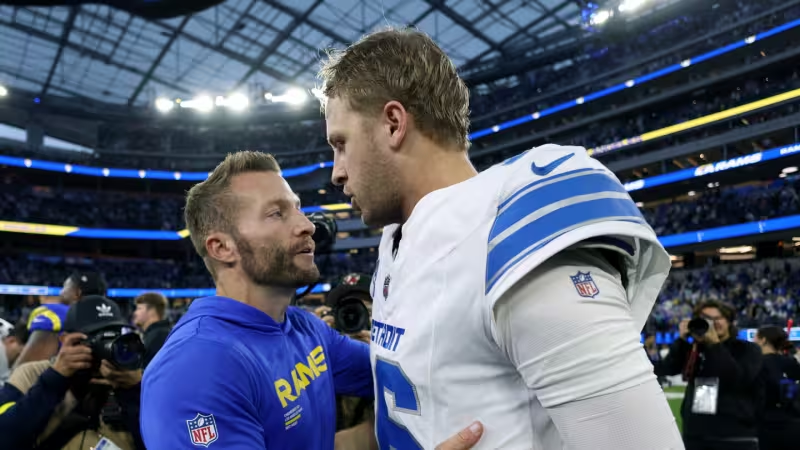
Sean McVay told the podcast Bussin’ With The Boys that he should have warned Jared Goff before the Rams traded him to Detroit in the deal that brought Matthew Stafford to Los Angeles.
McVay called his handling of the move a mistake on several levels: "I’m super sensitive to what an amateur I was with the Goff situation, trading him," he said, adding repeatedly that "I didn’t handle that the right way" and "There was nobody to blame but myself."

The trade itself was stark in its cost and consequence. In January 2021 Detroit traded Matthew Stafford to the Rams in exchange for Jared Goff, two first-round picks and a third-round pick—the first-rounders were the 2022 and 2023 selections. The Rams went on to win the Super Bowl behind Stafford the next season. Detroit, which had been a three-win team in 2021, turned that corner after the swap and posted four straight winning seasons. Goff threw for over 21,000 yards in his first five seasons in Detroit and signed a four-year, $212 million extension with the Lions.
Those results underline why the episode still matters. McVay’s admission is not about roster construction or cap math: it’s about a coach’s promise of candor to a player whose career and finances were altered by the deal. McVay framed his comments as a lesson in communication. "You want to talk about lack of courage, lack of clarity, lack of ability to be able to look somebody in the eye that you’ve had a lot of really cool experiences with and tell him, ‘Hey, not easy to say, but we might explore an opportunity to acquire Matthew Stafford, and you’ll be a part of a trade there.’"
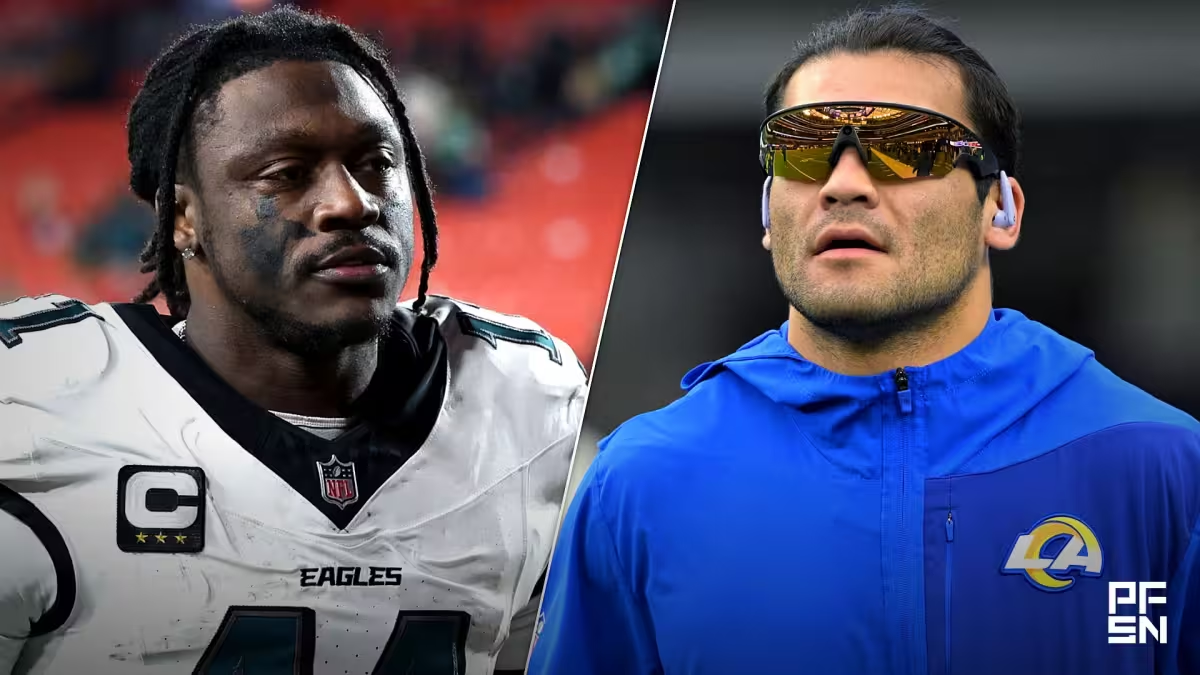
Goff has said he felt betrayed, and that the Rams never told him they were thinking of getting rid of him until just before the trade news broke. McVay acknowledged that he failed to have that conversation after the 2020 season: "Did I have the courage to sit him down after that season in 2020 and really tell him there’s a possibility we might explore some avenues that might lead to you not being our quarterback going forward? No. Would I handle it different now? Absolutely." He also said, "The important thing is to operate with clarity for people."
McVay’s candor carries a second, quieter line: he praised Goff’s reaction. "I appreciate his honesty in all of that," McVay said, a remark that mixes apology with a public nod to the player he traded away. But the trade reshaped two franchises, and outcomes do not erase the human strain of how the move unfolded.
The tension is simple and sharp. The Rams achieved the highest team reward after acquiring Stafford; the Lions improved markedly with Goff under center. Yet McVay says he was an "amateur" in the way he navigated the switch and that the failure was personal. That gap—between professional success and personal mishandling of a player relationship—is what he repeatedly returned to in his remarks.
McVay's retrospective promises—that he would handle the situation differently and that clarity is essential—are as close to a resolution as exists in the public record. For Jared Goff, however, the moment remains a rupture he described as betrayal: a player who was extended for four years and $212 million and then learned his fate only at the edge of a trade announcement. The deals and the titles stand; McVay’s contrition is now part of the story he helped write, but it does not undo the way Goff says he was left in the dark.



