



In Zaire’s 1974 World Cup game against Brazil, Mwepu Ilunga walked out of the defensive wall and launched a Brazil free kick — taken from about 25 yards — downfield after the referee’s whistle, even though Brazil was not quite ready. The referee, Nicolae Rainea, booked Ilunga with a yellow card for the action.
The kick became one of the tournament’s most replayed images and a shorthand for incompetence: a commentator later called it a "bizarre moment of African ignorance," and contemporaneous accounts labelled Zaire’s display as "African amateurism" and the players "clowns of football." Those blunt tags fixed the episode in the popular memory long after the final whistle.

That memory sits badly against Ilunga’s record. He first played for Zaire in 1971 and by 1974 had won domestic, continental and international titles, including the Africa Cup of Nations in March 1974. Zaire arrived at the World Cup after qualifying with a 100 per cent record and as the first country from sub‑Saharan Africa to reach the finals — far from a collection of amateurs.
Ilunga himself rejected the ignorance narrative. In 2010 he said, "I knew the rules very well" and added plainly, "I did that deliberately." He told Jon Spurling that the team had been summoned to the presidential mansion after qualification and that, "You have to remember that for many of us, who’d been raised in poverty, meeting Mobutu was like meeting a god," and that the players noticed Mobutu’s staff becoming agitated.
Put simply: the act that television replayed as a blunder was, by Ilunga’s account, a conscious decision by an experienced international defender. The referee’s whistle, the ball’s placement roughly 25 yards out, Ilunga’s break from the wall and the yellow card are the uncontested mechanics of the moment; the motive is where reporting and memory diverged.
The match and the reaction to it cannot be separated from Zaire’s political context. Mobutu Sese Seko had ruled since 1965 and changed the country’s name from Congo to Zaire in 1971. The national team’s success—winning the continent and then visiting the presidential mansion—was folded into an image campaign. Mobutu rarely left his residence because he feared assassination, and state pageantry around the squad magnified any move the players made, on or off the pitch.
That context helps explain why a deliberate act could be read so quickly as stupidity. A single clip, stripped of the backstory about the players’ standing, the trip to the presidential palace and Ilunga’s own words, satisfied a ready narrative: one that flattened politics into comedy and experience into exoticism.
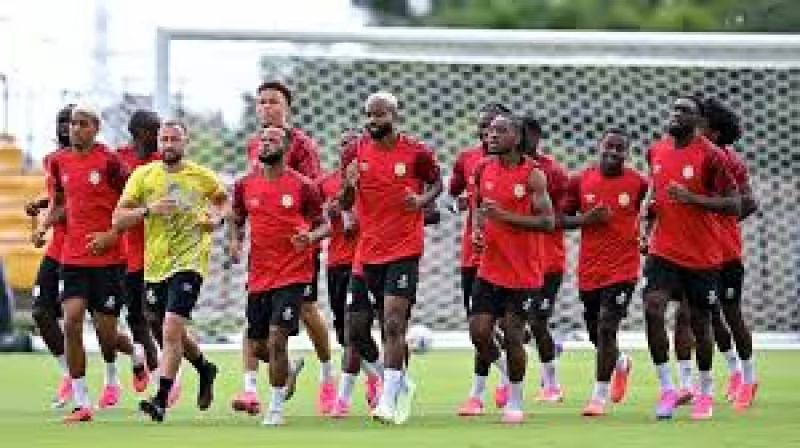
The renewed spotlight comes from the present. DR Congo, the country formerly called Zaire, has returned to the World Cup after 52 years, and that fact has nudged the old clip back into circulation. The new generation can revisit the image with fresh eyes — and with the available facts about Ilunga’s career and his own insistence that he knew the rules and acted deliberately. For contemporary readers, Filmogaz has recent match coverage that touches on related names and players (see and
The immediate correction is simple: Ilunga did not stumble through a rulebook; he chose to take the ball. The harder question remains unresolved. What precisely in the presidential meetings or the behaviour of officials pushed him to act at that moment — to court a booking rather than allow Brazil to take the kick as expected — is not settled by the footage or by his later statements. His admission changes the story’s moral, but it does not exhaust the backstory that turned a deliberate act into a global joke.



