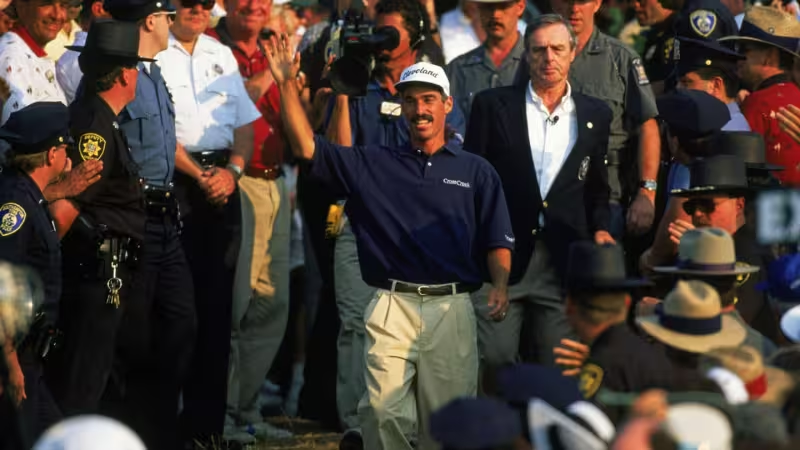
Corey Pavin stood on the 18th fairway at Shinnecock Hills in 1995 with a one-shot lead, 228 yards from the pin, and made a choice that shaped the afternoon: he selected a 4-wood and committed to a little draw toward the right edge of the green. "The wind was blowing 15, 20 miles an hour right to left. I could see the top of the flag. That was it," he recalled years later.
Pavin’s drive had finished on the right side of the fairway, leaving him a long second into a par-4 where par or better would likely win his first major. He said he aimed at the right edge of the green and tried to hit a little draw. "I decided to aim at the right edge of green and hit a little draw. The second I hit it I knew it was good," he said.

The numbers make the moment raw: 228 yards, a 35-year-old PGA Tour veteran, a 4-wood in hand, and a crosswind gusting 15 to 20 miles an hour that would push any miss well left. Pavin’s clubhead met the ball and the ball landed in the rough in front of the green before bouncing up toward the hole — a result that looked as if it had been engineered more by conviction than chance.
NBC’s broadcast captured the drama in real time. As the ball bounded and tracked toward the green, color commentator Johnny Miller warned viewers with a line that has lived in highlight reels: "Watch out for this one! This is the shot of his life!" That exclamation folded the shot into U.S. Open lore and into Pavin’s own story as a player suddenly on the brink of a major.
That brink is where golf’s simple arithmetic becomes anything but. Pavin arrived at the closing hole knowing par would probably secure the trophy; he also knew what a miss could mean. Greg Norman was playing two groups behind and within striking distance. If Pavin had stumbled on 18, Norman still had holes to play and the margin could have evaporated. The shot’s value, then, was not merely distance or trajectory but a pressure defusing: it reduced the number of clear ways for a challenger to take the lead.
The detail Pavin remembers — that he could see only the top of the flag — matters because it explains the shot’s geometry. With the flag barely visible and the wind pushing right to left, aiming at the right edge and letting the ball draw in required faith in both the club selection and the swing shape. Using a 4-wood from 228 yards in those conditions was a deliberate, risk-managing decision; it was intended to keep the ball in play and funnel it toward the target rather than shoot over or left of it.
What followed — the ball hitting the rough short of the green and bouncing up toward the hole — delivered exactly the sort of low-variance payoff Pavin sought. It left him in position to walk away from the 72nd hole with the kind of score that, in his estimation then and now, would almost certainly be enough. It also left the tournament’s narrative balanced on a single, hard-edged act: one veteran thinking through wind, yardage and leverage, and executing a shot under near-maximum strain.
Shinnecock Hills, the site of that moment, is again hosting the championship this year, which is why the 4-wood from 1995 keeps surfacing in broadcasts and previews. The shot is a compact lesson in decision-making under duress — how a choice as granular as club selection from 228 yards can rearrange the possibilities across an entire leaderboard. It is also the precise instant that critics, fans and fellow players point to when asked for a single image from that U.S. Open.
Whether that one swing directly sealed Pavin’s first major is the seam that keeps the shot alive in memory: it handed him the position where par or better would likely win and it put pressure back on a pursuer two groups behind. In the retelling, the 4-wood is not merely a stroke of good fortune but the consequence of a clear decision — to aim right, to shape the ball left, to trust the club — and it remains the defining choice of that final hole at Shinnecock.