




Joshua Báez turned a Tuesday night at Triple‑A Memphis into a scoreboard headline, hitting three home runs across the first five innings of the Redbirds’ game against Triple‑A Nashville and leaving no doubt he belongs on the promotional radar.
The 22‑year‑old is making that argument with numbers. Through his first time at Triple‑A Memphis he was hitting.274/.346/.591, and he entered Tuesday slashing.271/.337/.579 with a.916 OPS — totals that included 19 homers, 51 RBIs, 12 stolen bases and 13 doubles in 61 games. By the night’s end he had 22 homers and 57 RBIs in 62 games, ledger lines that pushed a recent profile to call his case for promotion increasingly difficult to deny and described his streak as unstoppable.

Those figures aren’t abstract. They are the clearest evidence that Báez’s bat has carried seamlessly to the highest minor‑league level: power, on‑base, extra bases and the rare speed to make him a multi‑dimensional threat. The three‑homer game is the sort of single performance that forces front offices to answer questions they have been able to postpone when a prospect’s resume is merely promising instead of overwhelming.
Context complicates the obvious next step. The Cardinals are an organization with a crowded outfield and a club that has been playing well — 37‑29 overall and 7‑3 in their last 10 games — leaving little appetite for disruptive roster tinkering. Lars Nootbaar joined the big‑league squad for the first time this season last week, and Nathan Church returned from the injured list over the weekend. Jordan Walker is getting reps in right field, Church is handling center, and Nootbaar has been in the outfield rotation as well; meanwhile Bryan Torres and Nelson Velázquez have been shifted to the bench after those moves.
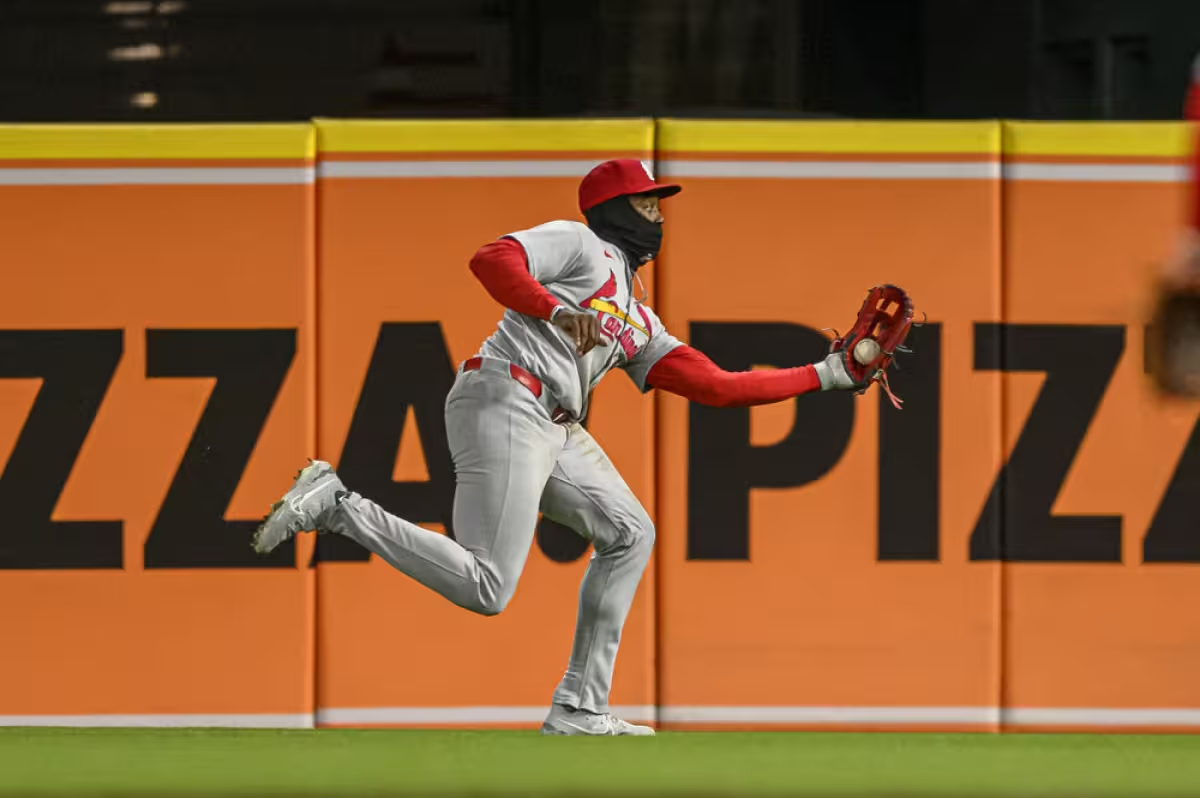

That alignment is the exact problem Báez’s numbers create: the obstacle to a promotion is not production but fit. The club has already cobbled lineup flexibility — Iván Herrera has been used at designated hitter when not catching — to accommodate its current mix. Adding another outfielder who needs regular at‑bats raises immediate questions about who loses playing time and which defensive alignment the team is willing to accept.
There is also a timing element. Báez is only in his first Triple‑A stint and his surge arrived as the major‑league roster regained health and depth. A promotion would force the Cardinals into a roster decision that affects more than one player: it would determine whether someone already on the roster becomes a part‑time option, moves to the bench permanently, or is optioned in turn. That is the practical friction behind headlines about prospects and callups.
The unbeaten argument in Báez’s favor is simple: he has produced at a level that usually earns a long look. The counterargument is equally straightforward: St. Louis currently has limited, usable openings in the outfield without rearranging a productive major‑league group. The numbers point to a player ready to challenge for playing time; the roster map says the club must choose whether to make room.
The most consequential unanswered question now is not whether Báez deserves a shot — by the numbers, he does — but whether the Cardinals will create an opening that guarantees him consistent major‑league at‑bats. That is the decision that will tell whether his three‑homer night accelerates a promotion or becomes another powerful argument for patience.



