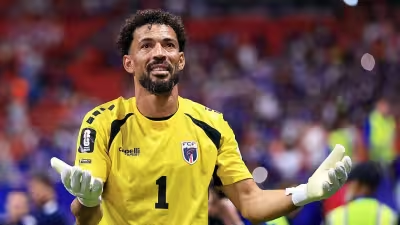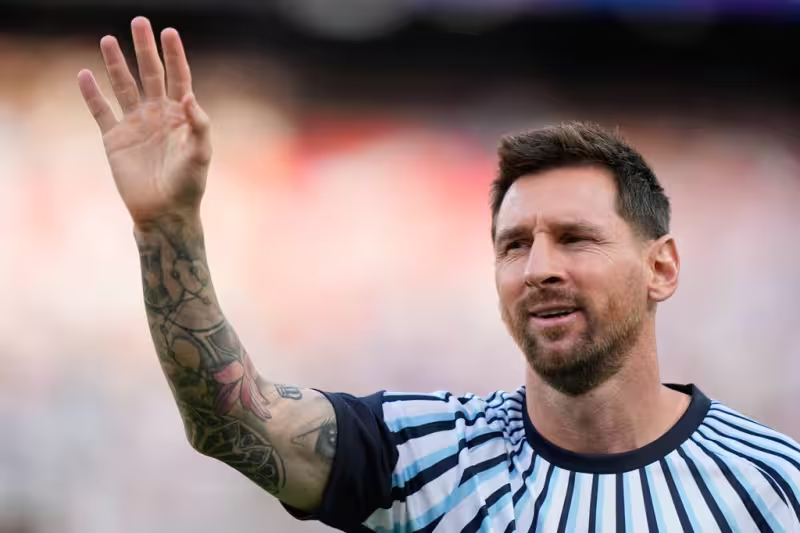
Lionel Messi will make his first appearance Tuesday in the World Cup in North America, beginning what his camp frames as a final tournament run that will push him into rare company: he is one of only three footballers to reach six World Cups.
Messi arrives with 13 World Cup goals and 16 match victories across five previous tournaments, numbers that set a clear headline for what to watch. Miroslav Klose remains the all-time World Cup scorer with 16 goals. Kylian Mbappé sits on 12, just behind Messi, and the single-tournament high-water mark — Just Fontaine’s 13 goals in Sweden in 1958 — remains intact as a historic benchmark.

That arithmetic frames both the immediate stakes and the broader significance. A goal in Argentina’s opener would cut Messi’s gap to Klose to two. A multi-goal tournament would put the 13-goal Messi closer to Fontaine’s one-tournament haul and within shouting distance of the overall record that has survived three generations.
Context sharpens the moment. Messi has played World Cups in 2006, 2010, 2014, 2018 and 2022. He won the trophy in Qatar in 2022 and comes into this edition almost 39 years old, with Argentina appearances and personal milestones giving extra meaning to each match. Cristiano Ronaldo and goalkeeper Guillermo Ochoa are the only other players to reach six World Cups, a small club that underscores how rare sustained international careers have become.

The friction in the story is simple and specific: Messi’s legacy is already secured by a World Cup title, but records still sit in reach and just out of reach at the same time. He is three goals behind Klose’s all-time mark. He has matched Fontaine’s single-tournament total only by accumulating goals across five editions, not in one. Kylian Mbappé, younger by more than a decade, is positioned to chase the same scoring conversation from a different angle, and Klose’s own World Cup résumé includes 17 victories in four appearances — one more than Messi has amassed to date.
Practically, what matters on Tuesday is straightforward. Messi’s scoring count is 13; any addition will immediately change the arithmetic at the top of the goleadores de los mundiales lists. Argentina’s opener offers the first real window. Where he plays in the team, how often he gets clear chances and how match fitness holds up at almost 39 will determine whether this event becomes a late-career scoring surge or a tidy coda to an already historic run.
Look for two immediate signs in the opening match. First, how Argentina arranges attacking support around Messi — service from wide areas and late runs into the box will either create or limit straightforward chances. Second, whether Messi is positioned to finish those chances himself or to orchestrate them for teammates; a primary scorer needs opportunities inside the penalty area to chip away at Klose’s total, while a playmaking role would slow any chase.
Previous tournament exits are part of the backdrop. Messi’s Argentina were eliminated in the quarterfinals in 2010 and in the round of 16 in 2018 before the 2022 triumph. Those earlier exits left open the scoring questions that now feel immediate again: not just whether Messi can add to his 13 goals, but whether he can do so enough times to close a three-goal gap to the all-time lead and to challenge Fontaine’s 13-goal single-tournament mark.
The clearest unanswered question at kickoff is also the most consequential: will this last World Cup be the stage where Messi finally overturns Miroslav Klose’s 16-goal record, or will it end as a final, eloquent chapter in a career defined more by trophies than by topping the goleadores de los mundiales leaderboard? The answer begins to arrive Tuesday, in the first half of Argentina’s campaign.