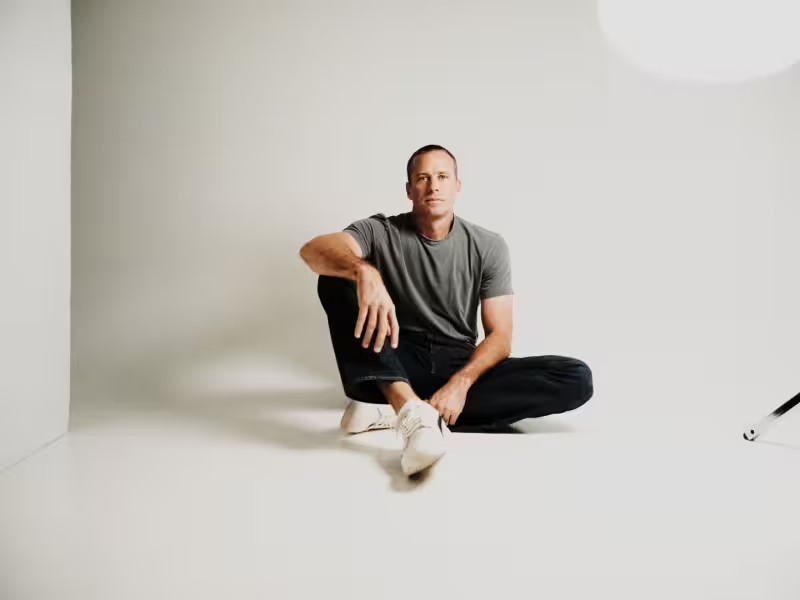
"I made these problems for myself," Armie Hammer told a writer during his first major sit-down in years with The Hollywood Reporter, an opening admission that set the tone for a conversation about a career he says he wants back.
The interview, published under the headline "Armie Hammer Wants a Second Chance: “I Made These Problems for Myself” (Exclusive)," lays out a man who says he is trying to rebuild after a public collapse: Hammer said he spent five years with no work, lived for a stretch in a 200-square-foot flat in Venice Beach, paid for groceries with a debit card a friend had pressed into his hand and carried a burner flip phone he bought at a gas station.

Hammer, 39 and 6-foot-5, told the writer he was prepared to take anything to get back into public life — "I would have done a f***ing cat food commercial," he said — and described the practical and emotional fallout of those years away from screens and sets.
He met the writer Tuesday night in June in West Hollywood and, at moments, sounded plainly exhausted by the run of his own choices. "I used to call myself a consumer," he said, listing what he chased: "Drinks, women, validation, experiences — I just wanted to consume. All of it. More, more, more." He added, "I called my publicist on the way here," a line that underlined how unusual the sit-down was for someone who has been largely absent from publicity.

The interview stitches those small, gritty details to a larger arc. Hammer recalled arriving at a point when roles that once seemed inevitable were no longer available: his breakthrough came playing both Winklevoss twins in David Fincher’s The Social Network, and Call Me by Your Name was about to open in November 2017 when he and the writer last had dinner together in Malibu. After the scandal that followed, the narrative of a rising star unraveled into years spent away from the industry.
The profile also follows Hammer geographically and emotionally: he said he went to the Cayman Islands, built a farm and lived through a period of reduced means; the writer notes the 200-square-foot Venice flat and the borrowed debit card as examples of how fully his public life had contracted. "Do you think anything Seth can write is going to move the needle compared to what I’ve been through the last five years?" Hammer asked at one point, a rhetorical question that framed both his pain and his hope for forgiveness.
That hope is the essential friction of the piece. Hammer asks for a second chance, repeatedly and plainly, yet the interview itself records the scale and duration of the damage: five years without work is not a pause so much as an exile from the business that once defined him. The details — the flip phone, the modest flat, the friend’s debit card — make the claim that he is ready to return feel urgent, but they also underscore how far he has fallen from the mooted prospects of the past.
Facts in the conversation puncture easy redemption. Hammer is the great-grandson of Russian-Jewish oil tycoon Armand Hammer, and his early career included films such as The Lone Ranger and The Man From U.N.C.L.E., but the interview avoids a tidy comeback narrative. He admits culpability — "I made these problems for myself" — and insists he wants another shot. He jokes and deflects and, at times, tries to measure whether the written word or a public performance can actually alter what he has spent half a decade living through.
The close of the profile is unflinching: Hammer says he wants to pull his career out of the ruins, but he offers no new project, no imminent role and no guarantee that the industry will accept him back. The most concrete thing he supplies is his own acknowledgment of responsibility and a willingness, he says, to try — which leaves the central question answered only in intention. He can ask for a second chance; whether Hollywood will give one remains unresolved, and for now his comeback is a declaration rather than a fact.