By Josimar Dias
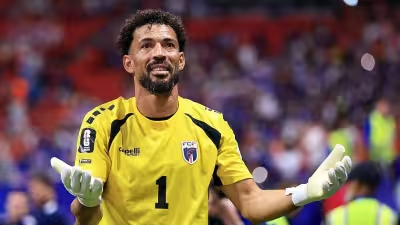
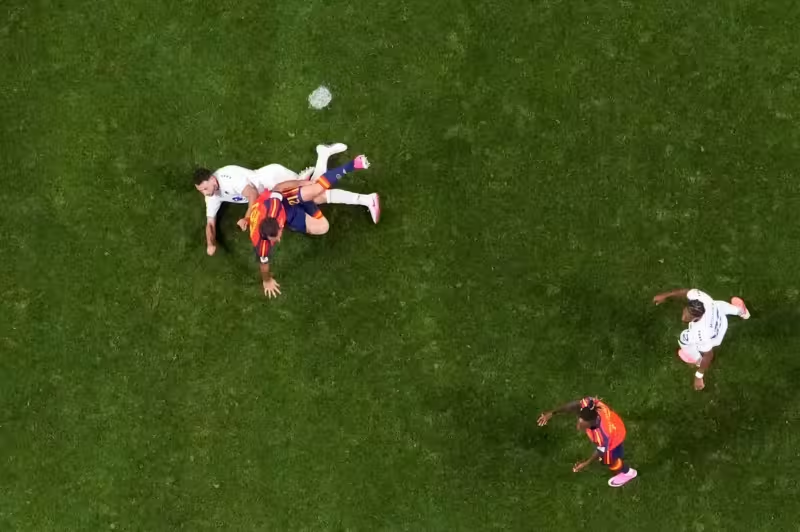
Cabo Verde opened its first World Cup with a 0 a 0 draw against Espanha in Atlanta, and in the process set a tournament record by committing just one foul in the match, a low that rewrites the competition’s statistical ledger.

The single-infraction mark comes from Opta’s historical play-by-play tracking, which the statistician has maintained for World Cups since 1966. The one-foul total is the fewest recorded in any match across that span and arrives in the same tournament where low-foul games have already been notable.
Earlier in the 2026 World Cup, Turquia had registered the fewest fouls in a match before Cabo Verde’s game — four infractions in a 2 a 0 loss to Austrália — making Cabo Verde’s figure a sharp outlier even inside a tournament trending toward cleaner play.
The numbers are simple: 0 a 0 on the scoreboard, one foul by Cabo Verde, and a recordline that reaches back to 1966. Those facts place the result beyond a typical draw; it is now a statistical milestone attached to a nation making its first appearance on football’s biggest stage.



Yet the headline tension is immediate. Discipline at the level implied by a single foul would ordinarily be a foundation for victory; here it yielded only a scoreless draw. Cabo Verde’s ability to avoid contact that draws referee attention did not translate into the goal that would have turned a tidy defensive night into three points.
The contrast with Turquia’s earlier match deepens the puzzle. Turquia’s four fouls came in a game they lost 2 a 0 to Austrália, showing that a low foul count does not guarantee control of results. Cabo Verde’s one foul amplifies the question rather than resolving it: is the stat a marker of superior positioning and timing, a conservative tactical plan that sacrifices attacking risk, or simply an unusual distribution of referee decisions in a single game?
The available data do not answer that question. There is no account here of how Cabo Verde structured its approach, who carried the attacking burden, or which moments defined the match inside the 90 minutes. What exists is a record — a single foul, a goalless draw, and the fact of a first-ever World Cup appearance for Cabo Verde — and the gap between the tidy stat line and the ordinary outcome of not winning.
For tournament watchers and statisticians, the match will be logged as a curiosity: the fewest fouls since Opta began tracking in 1966. For Cabo Verde’s coaching staff and players, the scoreline will carry the usual weight of a point taken and two points dropped. Which of those perspectives matters most depends on what comes next for the island nation in the group stage and whether the team can convert defensive discipline into goals.
The most consequential unanswered question is practical and immediate: can Cabo Verde turn the defensive control implied by one foul into the attacking returns a debutant team needs to advance? The record stands; the wider significance will be decided in matches that follow and in whether the team can translate that unusual discipline into wins.