



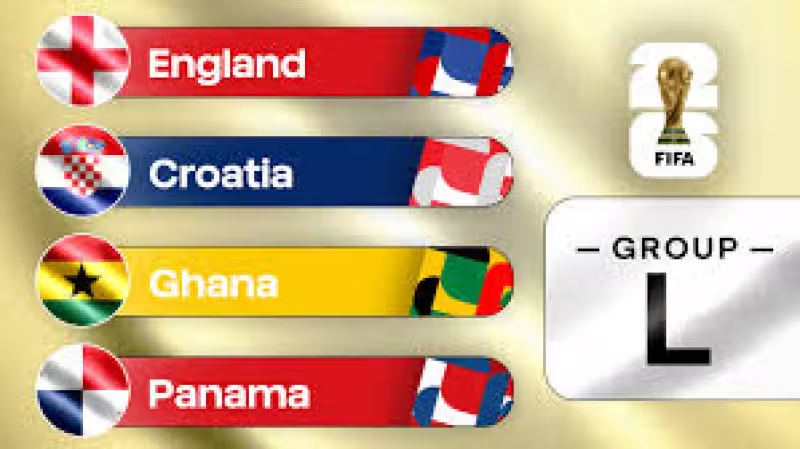
If England finish top of Group L at the 2026 FIFA World Cup, projections put their last-32 opponent as DR Congo — most likely on 1 July in Atlanta — setting a potential route through Mexico and Brazil on the way to the later rounds.
That line comes from 10,000 Opta tournament simulations that have England advancing to the knockout stage in 96% of runs and winning Group L in 67.9% of them. England head Group L alongside Croatia, Ghana and Panama; Croatia are judged the next-most likely to advance from the pool at 77.8%, with Ghana at 49.7% and Panama at 39.4%.

Under the expanded 48-team format, group winners meet one of the eight best third-placed sides in the Round of 32. The simulations show the winners of Group L drawing a third-placed team from Groups E, H, I, J or K, and those third-place spots are most likely to be taken by Côte d’Ivoire, Saudi Arabia, Senegal, Algeria and DR Congo. Significantly, the winners of Group L end up playing the third-placed team from Group K in 330 of 495 possible combinations — the mathematical reason DR Congo is the single likeliest opponent.



The projection that England would face DR Congo is useful shorthand, but it is not certain. The bracket still allows for 495 different third-place permutations across the qualifying groups, and any one of those permutations would change England’s Round of 32 opponent. In plain terms: simulations point to DR Congo most often, but the actual draw depends on which third-placed teams emerge from E, H, I, J and K when the group stage finishes.
If England do meet DR Congo and progress, the simulations place their next match against co-host Mexico in Mexico City on 5 July; Mexico are the likeliest side to top Group A at 47.8%. England’s only previous World Cup meeting with Mexico came in 1966, a 2-0 win, and a victory over Mexico in 2026 would, according to the same projections, set up a quarter-final against Brazil in New Jersey on 11 July. Brazil remain the tournament’s most decorated nation with five World Cup titles.
Practical takeaways for supporters tracking world cup fixtures: the clearest immediate headline is the DR Congo projection for 1 July, but the more important variables are results across Groups E, H, I, J and K and the exact order in Group L. England’s path — a matchup with an African opponent first, then a likely tie in Mexico City and a projected meeting with Brazil — is coherent only if the group outcomes follow the most probable lines in the simulations.
The key unanswered question is precise: which third-placed team will qualify from the five groups whose runners-up feed the Group L winner’s bracket? That single variable, among 495 permutations, decides whether England get the DR Congo test in Atlanta or a different opponent entirely. Fans and coaches can use the simulations as a planning tool, but the actual world cup fixtures will only lock in once group play is complete.



