



Ousmane Dembélé said leaving Barcelona for Paris Saint-Germain in 2023 was the "best decision," a blunt judgment that arrived with a clear beneficiary: himself. The forward put the move at the centre of a professional reboot and gave direct credit to Luis Enrique's vision for the role he now occupies at PSG.
Those comments were published in a PSG daily news roundup on Monday 15th, which carried Dembélé's remark and his explicit nod to Luis Enrique. The line — short, sharp and hard to miss — frames the transfer as a turning point rather than a detour.

The weight of the moment is in the detail Dembélé chose to supply. He did not hedge. He linked a major life change, the 2023 departure from Barcelona, to a concrete improvement in his career at PSG and named the coach whose plan, he said, made it possible. For a player whose stock was uneven before the move, that pairing of decision and credit matters as evidence of a deliberate reset.
Context follows the claim. Dembélé is rebuilding his reputation in Paris and, in the same breath, winning medals in the city where he relocated two years ago. Those are the two facts that give his endorsement of the transfer substance: this is not just a rhetorical comfort with a new contract, it is a public framing of a career trajectory that includes on-field reward.
There is friction in that portrait. Saying a move was the "best decision" underlines a conclusion; acknowledging a need to rebuild underscores an incomplete story. The two lines — triumph and reconstruction — do not sit comfortably together. Rebuilding a reputation implies prior decline or doubts. Praising the move as decisive implies certainty. That gap is where the real narrative lives: Dembélé celebrates his return to form even as he acknowledges the work it has taken to get there.
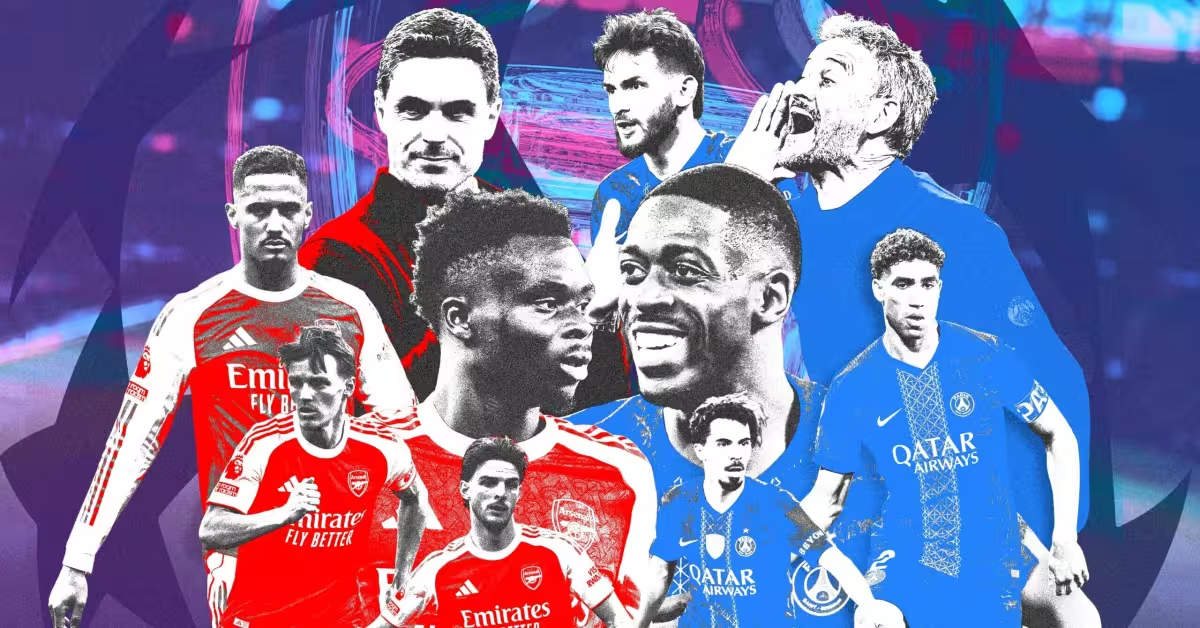
Credit to Luis Enrique is the clearest operational detail Dembélé supplied. Naming a coach ties the personal verdict to a tactical and managerial reality. It is a rare, specific acknowledgement in a public field of statements that often lean generic. For PSG, the endorsement matters: it suggests the player believes he has been given a defined role and that the club’s leadership has delivered on promises that matter to him.
Why this matters today is straightforward. The comments are fresh, logged in the Monday 15th roundup, and they reshape how observers read Dembélé’s time in Paris. They convert abstract talk of a "revival" into a player-made narrative: a transfer in 2023, a coach’s plan, medals as evidence. That chronology — move first, plan second, rewards third — is how Dembélé is asking to be judged.
The unresolved question is what comes next. Dembélé has tied his own rehabilitation to a coach and a club; what he has not answered is whether that rehabilitation will be sustained, broaden into consistent form or change how he is perceived long term. How his role under Luis Enrique will evolve and whether the current run of success will translate into an enduring reputation are the facts still missing from this account.
One more practical note: conversations about individual honours and recognition — Ballon D'or among them — orbit any player who talks openly about a career reset and visible rewards. Dembélé’s words supply a frame for those conversations, but they do not resolve them. The immediate, verifiable record remains: he left Barcelona in 2023, called that move the "best decision," credited Luis Enrique for his role at PSG, and is rebuilding his reputation while winning medals in Paris.
That sequence — decision, coach, medals — is the story Dembélé has chosen to tell. The test of it will be whether his on-field role and form under Luis Enrique endure long enough to make that judgment stick.



