
Microsoft’s valuation has reset as investors try to measure powerful AI-driven momentum against growing worries about capital spending, profit margins and execution risk.
The debate sharpened after a video published June 14 revisited market prices from June 8, 2026 — a day when MSFT rose 1.77% — and laid out reachable upside from Azure growth, agentic AI and a possible quantum breakthrough alongside the costs required to get there.

The arithmetic at stake is simple: Azure’s continued expansion, meaningful wins from agentic AI that can act autonomously for customers, and any quantum computing advance would materially expand Microsoft’s long-term earnings potential if the company can turn investment into recurring revenue and sustainable margins. Those possibilities are the upside that supports a higher MSFT stock price; they are also the reasons investors have kept valuations elevated despite near-term skepticism.
But the opposing force is real and measurable. Rising investor doubts center on three things — how much Microsoft must spend to keep pace in AI infrastructure, whether those outlays will compress margins before new revenue appears, and whether the company can execute new product monetization at scale. Put another way: strong technology momentum no longer automatically translates into a clear earnings path without proof that the spending produces repeatable cash flow.

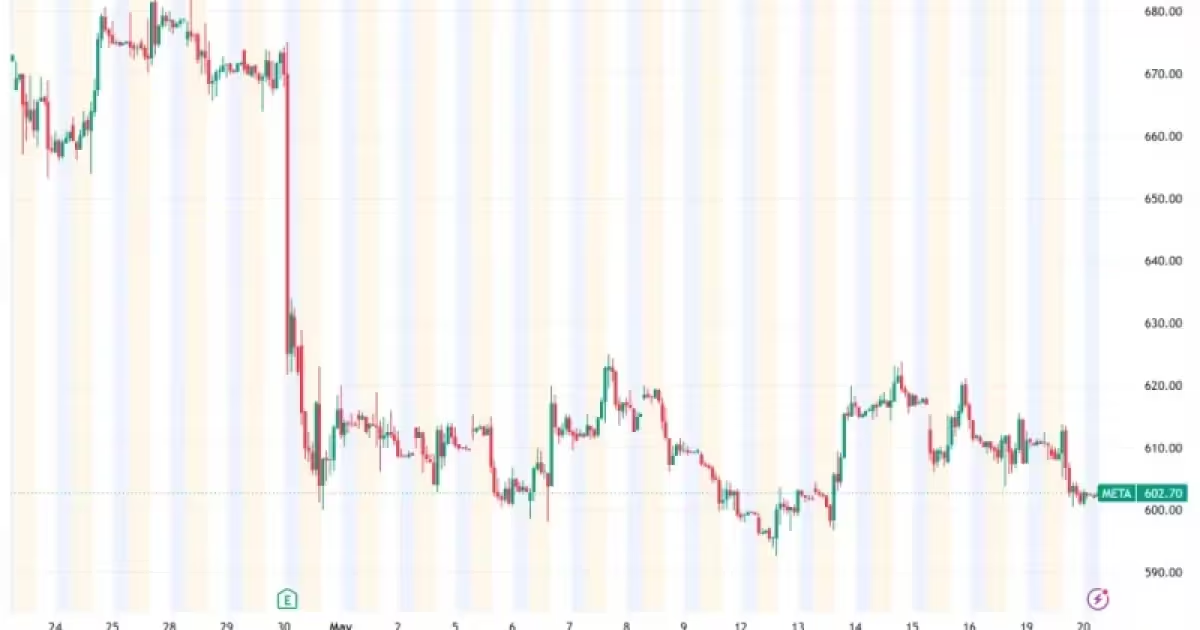

The immediate consequence is a valuation reset rather than a rerun of prior multiple expansion. Markets are treating AI momentum as conditional, not guaranteed. That shows up in price action: the MSFT stock price can move upward on good signals — as it did on June 8, when the market showed a 1.77% uptick — but the premium investors are willing to pay now depends on quarterly evidence that spending is converting into durable margin improvement and revenue uplift.
Where the debate tightens is on monetization mechanics. Azure growth can raise revenue, but infrastructure spend and price competition can blunt margin gains. Agentic AI products could command premium pricing only if they demonstrably reduce costs or open new revenue streams for enterprise customers. A quantum breakthrough would be disruptive only if Microsoft captures practical, near-term use cases and packages them into paid services. Each of those steps involves execution risk: timelines, customer adoption, and the degree to which Microsoft shoulders upfront costs before partners or customers pay for outcomes.
Investors watching guidance, capital expenditure plans and margin trajectories will be looking for one clear signal: evidence that AI-related capex is creating higher-margin, repeatable revenue rather than a long tail of cost. Absent that signal, the valuation is likely to remain disciplined — elevated relative to legacy peers because of AI potential, but capped until monetization is demonstrable.
The unresolved question that determines where the MSFT stock price goes next is how quickly and cleanly Microsoft can convert AI investment into profit. Until the company produces consistent, margin-accretive revenue from its AI work — whether via Azure expansion, agentic AI monetization, or commercialized quantum services — investors will treat much of the upside as conditional. The practical result: the market has reset expectations, and the next few quarters of spending guidance and margin performance will decide whether that reset is temporary or permanent.