



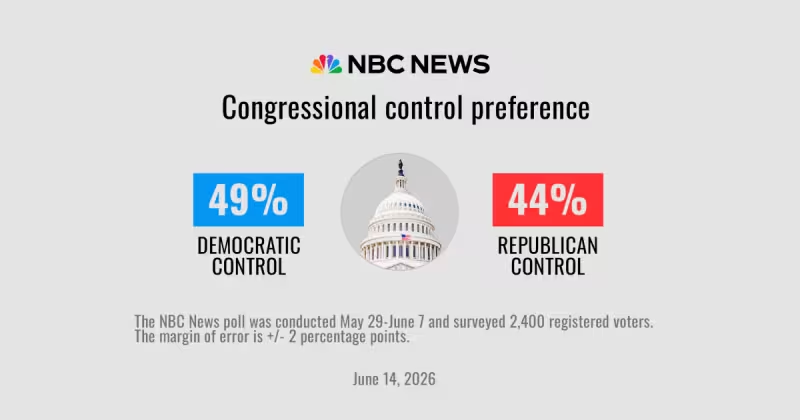
Democrats hold a 5-point edge over Republicans in the battle for control of Congress, a new national NBC News poll found, while President Donald Trump’s approval rating among registered voters has slipped to 42%, the lowest of his second term in the survey.
The poll showed 49% of registered voters prefer Democratic control of Congress after this year’s elections, compared with 44% who want Republicans in charge. Another 7% are unsure. That gap matters because it lands in the same polling window that has become a rough barometer for the midterms, with voters already signaling how they want the next Congress to look before campaigns fully harden.

Democrats’ lead is powered by strength among independents, who favor Democratic control by 46%-34%, a 12-point margin. Majorities of Black voters, Latino voters, voters under 50 and college graduates also prefer Democrats. Republicans, though, still hold an edge among men, white voters and voters without a college degree, a reminder that the map remains competitive even as the overall number tilts blue.



Trump’s numbers are weaker in the same survey. Among registered voters, 42% approve of his job as president, while 39% of all adults approve. Two-thirds of independents disapprove, along with 64% of Latinos and 77% of voters ages 18 to 29. Republicans remain strongly behind him, with 82% approving and 58% saying they strongly approve.
Bill McInturff, the Republican pollster who co-led the survey, said the numbers were rocky for Republicans but not catastrophic. His Democratic counterpart, Jeff Horwitt, said Republicans do not need this to be 2018, and argued Democrats are still in a very good position to win seats despite redistricting. The poll was sponsored by More Perfect, a nonpartisan nonprofit focused on democracy.
The context is plain enough: Democrats need to net just three House seats to take control because redistricting has narrowed the battlefield, but the Senate is a much steeper climb. They would need four seats, and several of the states they would have to win were carried by Trump by double digits in 2024. In the NBC News survey from March, Democrats led the generic ballot by 6 points, up from a tie in May 2022 and short of the 10-point edge they held in June 2018.
The unanswered question is not whether Democrats have an opening. It is whether a modest polling advantage, paired with Trump’s lowest approval reading of the term, can survive the pressure of candidate quality, turnout and a Senate map that still leans heavily against them. The next real test is the midterm elections themselves, and the polling edge means Democrats enter that fight in better shape than Republicans, even if not by enough to call the outcome settled.



