FIFA said the visible empty seats at the South Korea–Czech Republic match in Guadalajara on June 11 were caused in part by ticketed fans standing in concourses rather than occupying their assigned seats.
South Korea beat the Czech Republic 2-1 at Guadalajara Stadium in Zapopan; the venue seats 45,664 and the announced attendance was 44,985 — 679 short of capacity — even though many sections showed obvious gaps during the game.

FIFA pushed back on crowd estimates made from television and photos, saying bluntly that its numbers were based on scans at entry and the number of spectators inside the stadium footprint. "Official attendance figures reflect the number of tickets scanned and spectators present within the stadium footprint, rather than visual assessments of seating occupancy at any given moment during the match," the organization said, and added: "Please note that, during last night’s match in Guadalajara, several ticketed fans could be seen standing in concourses rather than staying in their assigned seats throughout the match."
The comment addresses a simple but striking mismatch: cameras and fans in the stands saw many empty spots in the middle tiers and empty seats scattered around hospitality areas even as FIFA published a figure that was just shy of full capacity. The contrast has become a talking point across early world cup football matches, where announced crowd totals have often been close to venue limits while broadcast shots revealed visible gaps.



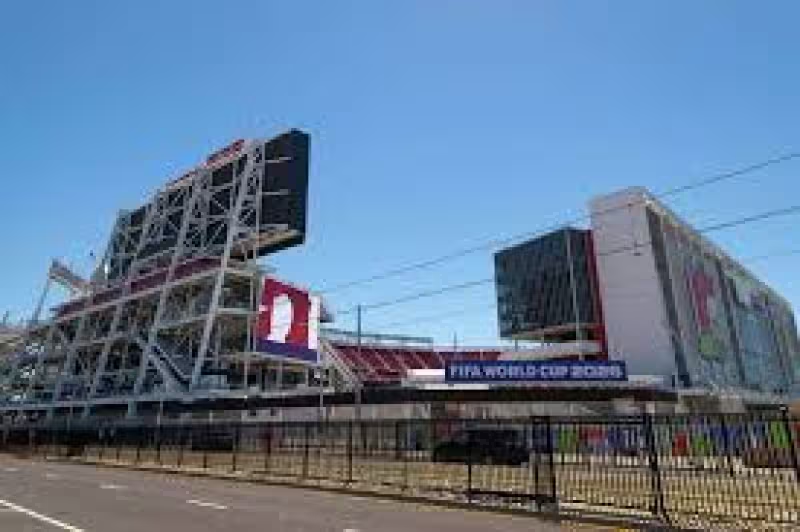
FIFA’s own figures suggest the pattern is not isolated. The opening six games of the tournament were 1,574 short of capacity in total, and another match two days later at Levi’s Stadium in Santa Clara was recorded with 67,966 in attendance against a capacity of 68,827 — a gap of 861 — with empty patches visible there as well.
The operational detail FIFA offered — counting ticket scans and people within the stadium footprint rather than relying on visual occupancy — explains how an event can be statistically near capacity even when many seats appear empty on camera. But it does not close the practical gap that spectators and television viewers noticed: an audience that is present but not seated creates the impression of a thinner crowd and raises questions about how attendance is experienced in real time.
The friction is concrete. FIFA’s method treats a scanned ticket and a person inside the footprint as a definitive presence; it does not distinguish between a spectator in their seat and one standing in a concourse for the whole match. What remains unclear is how many empty seats reflected ticket-holders lingering in public areas and how many were simply unoccupied because purchasers never arrived or left before kickoff.
The most consequential unanswered question now is whether FIFA or stadium operators will change how they report or manage attendance to match what viewers see live. Tournament organizers have defended the integrity of the numbers, but broadcasters, fans and local operators have a different concern: the optics of empty blocks during high‑profile games. Unless stadium policy or presentation changes — for example more active ushering, seat checks, or a different on-screen indication of scanned attendance versus seated occupancy — the discrepancy between counted attendance and visible seating is likely to recur over the coming world cup football matches.