




Zion Suzuki left Japan as a teenager to chase first‑team minutes in Europe; now 23 and wearing Parma’s shirt in Serie A, he is preparing to defend Japan’s goal at the 2026 World Cup. The move that defined him was not to fame but to playing time — a choice that has carried him from Urawa’s youth ranks to a club‑record transfer from Saint‑Trond.
The numbers that underline that choice are plain: Suzuki played 32 matches and kept six clean sheets in the Jupiler Pro League, a season of exposure that persuaded Saint‑Trond to sell him to Parma in the summer of 2024 for around 10 million euros — a fee that set a club record. Those appearances, not a marquee name, are what landed him in Serie A and put him in Japan’s plans for the World Cup.

Behind the move was a calculation widely praised back home. Louis Yamaguchi, who has followed Suzuki’s development, said the goalkeeper “made the decision to leave at the right time, because he had very little playing time at Urawa, even though he was seen as one of Japan’s top goalkeeping prospects. But he was very young and lacked experience.” Yamaguchi added that Suzuki “had offers from Manchester United and other big clubs when he left Japan, but he made the best choice by going to perhaps smaller clubs where he could play and earn his place.”
Suzuki’s résumé is compact and purposeful. Born August 21, 2002, in Newark, New Jersey, to a Ghanaian father and a Japanese mother, he moved to Japan shortly after his birth and grew up in Saitama Prefecture. He rose through the Urawa Red Diamonds youth system and signed his first professional contract at 16 years and five months, becoming the youngest player in Urawa history to reach that milestone. Japan’s coaches have tracked him from youth levels — U15, U16, U17, U18 and U23 — and he now represents the senior national side, the Blue Samurai.
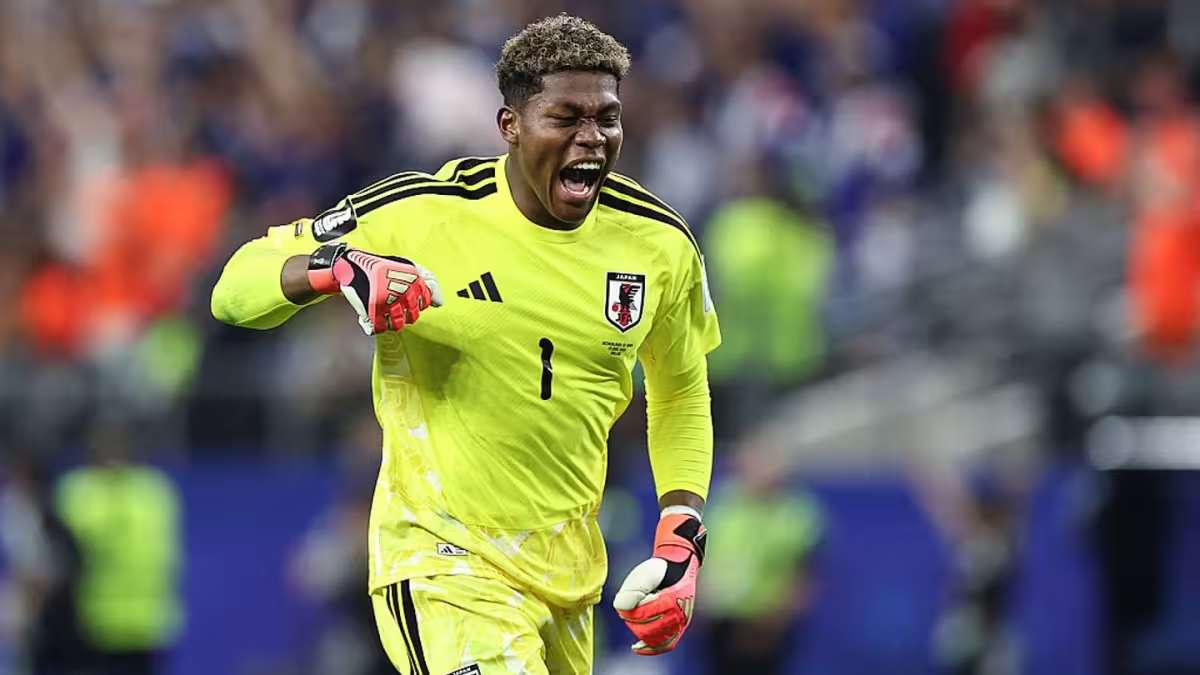
The choice to develop abroad has been framed by supporters and analysts as a model pathway for Japan’s talent: leave the domestic spotlight to gain experience in competitive European leagues. Yamaguchi summed that view up: “Choosing to go through Europe to develop is generally very well regarded in Japan,” and when those players appear on the World Cup stage, he said, “it also gives Japanese football more visibility.”
That public narrative collides with a quieter friction. Suzuki’s mixed heritage positions him as a visible symbol of a more diverse Japan, but the country remains largely ethnically homogeneous, and attitudes toward people of mixed race can range from curiosity to hostility. The record notes that he has “experienced this in the harshest way,” a reminder that his progress on the field has not insulated him from social frictions off it.
On the field, however, the decision to prioritise minutes over marquee destinations is the tangible argument for his World Cup role. Parma picked him up after his season in Belgium; Saint‑Trond had described him as an athletic goalkeeper with “great potential for development.” Those plaudits and the transfer fee signal belief in a player who chose steady senior minutes instead of waiting on the bench at a big club.
What is not yet settled is how Japan will use him at the tournament. He is available for the 2026 World Cup and carries fresh European experience, but the coaching staff’s selections and match‑day choices will determine whether that experience translates into starts in North America. Suzuki’s career so far presents a clear argument to pick him: he left early, played often, and earned a big‑money move — now the national team must decide whether that path ends with him between the posts on the world stage.



