



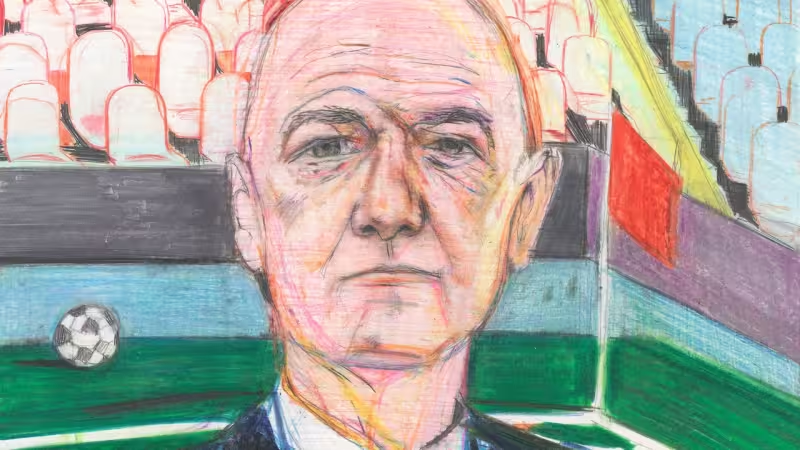
Gianni Infantino has a memory he visits when the calendar turns to World Cup year: as a twelve‑year‑old in 1982, watching Italy lift the trophy, he felt football enter him in a way he still uses to explain what the sport means. "For me personally, I think that the 1982 World Cup was definitely the moment when the football virus... became part of my life and my body," he said in a 2021 speech, adding that the same tournament "allowed us to grow."
Infantino’s remark is more than nostalgia. It is a personal origin story that the president of FIFA invokes at a moment when the World Cup is about to change shape: the 2026 World Cup will be the first staged across three nations—United States, Mexico, and Canada—will feature forty‑eight teams and a hundred and four matches, and is scheduled from June 11th to July 19th. For a man whose passion dates to Brig in 1982, the expansion reads as an extension of a lifelong mission to make football as large and as global as the memory that drove him.

The memory traces a specific childhood. Infantino was living in Brig, a small Swiss Alpine town, when Italy won the 1982 World Cup. His parents were Italian migrants: his father worked on the night trains that ran under the mountains and across Europe, and his mother managed a kiosk at the railway station. Those working‑class roots, and the discrimination that many Italians faced in Switzerland during his youth, are the scene against which he frames football as a vehicle of belonging and growth.

That personal framing matters because the 2026 tournament will be unlike any World Cup before it. FIFA’s next tournament widens the field from thirty‑two to forty‑eight nations and spreads a hundred and four matches across three countries over five weeks — a scale designed to reach new markets and deliver more games. For Infantino, who links the sport’s capacity to change lives back to a single childhood summer, the expansion looks like the institutional version of his conviction: bigger tournaments, more opportunities, a broader footprint.
But the scale also produces a paradox. The 2026 Cup will be hosted largely in the United States, a country where soccer has not historically occupied the cultural center the way it does in parts of Europe and Latin America. The tournament’s sprawling geography and bloated schedule risk turning a global festival into a diffuse spectacle — grand in size, but for many Americans likely an event felt as a sporadic, stadium‑by‑stadium curiosity rather than a shared national moment.
That contradiction—between a president whose attachment to one summer in 1982 shaped his language and an expanded World Cup that may register unevenly inside its principal host country—raises a practical question FIFA has not fully answered: how will Infantino’s personal conviction translate into the decisions that shape the tournament experience, from scheduling and broadcasting to which cities feel the World Cup in their daily lives? The 2026 schedule is set to begin June 11th and end July 19th, and those choices will be made and judged in real time as matches kick off.



