Rich Castellano remembers where he was the night the New York Knicks beat the Los Angeles Lakers in the 1973 NBA Finals — a 22-year-old fan watching a team that, he says, made the game look like passing class. "I see a lot of that in this 2026 team," Castellano told FilmoGaz, and he has spent more than four decades turning that lesson into a coaching philosophy; he has led Northport High School since the 1979-80 season.
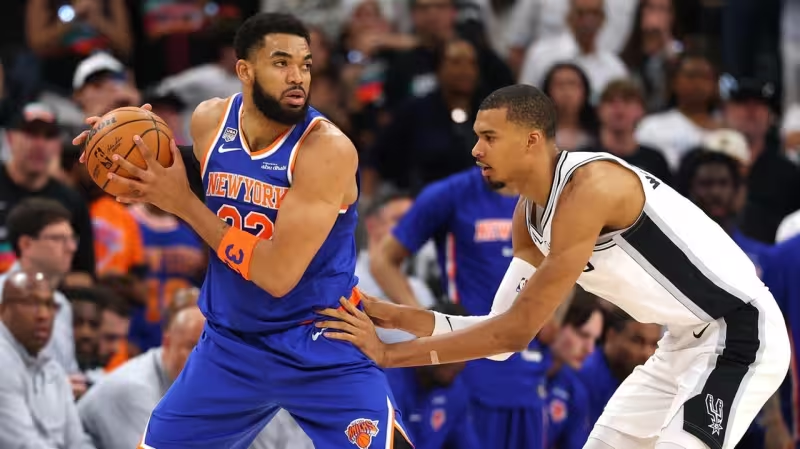
Catalyzing his comparison is the recent run that made the Knicks feel like a clinic in shared responsibility: an NBA-record 273-point differential during a 13-game winning streak, three playoff losses across that stretch and a streak that finally snapped Monday night in a 115-111 loss at Madison Square Garden. Castellano singled out the players he watches in his own practices — "Whether it be [Josh] Hart or [Deuce] McBride or Mitchell Robinson or [Karl-Anthony] Towns, all the guys share the ball. They look out for one another" — and he pointed to bench pieces who have answered the bell when needed.

That next-man-up depth is part memory, part modern roster construction. Castellano, who teaches as much as he coaches — "coaching is teaching," he said — compared the Knicks’ rotation and ball movement to the 1973 club because both teams reward the passer as much as the scorer. He added a practical preference: "I’ll take five great team players instead of three players with two superstars. I’d rather people try to stop five than stop one, and I think that’s what happens to the Knicks." He also noted the role of coaching in forming that identity, calling Tom Thibodeau "a great coach and a great teacher" and saying of assistant Mike Brown, "He definitely has heart and a desire; you can see him halfway on the court when there’s a foul."
The coaches who teach teenagers on Long Island see concrete examples they can use. When Jalen Brunson had early struggles in Games 1 and 2 of the playoff series against San Antonio, Jose Alvarado and Landry Shamet "stepped up," Castellano said — exactly the sort of bench response Bill Mitaritonna praises. Mitaritonna, who became a Knicks fan "as soon as Patrick Ewing got drafted" and who still recalls watching a Madison Square Garden game against Michael Jordan’s Bulls on Dec. 23, 1987 (when Gerald Wilkins held Jordan to 16 points over 39 minutes), said the current postseason depth matters as a teaching point: "It’s a great way for us as high school coaches to tell them that everybody’s important on a team, no matter when your number is called."
Plainedge coach Sarah Tansey traced the team’s evolution to recent playoff experience, calling Eastern Conference semifinal appearances in 2023 and 2024 and a conference finals series in 2025 "served as catalysts" for the chemistry teachers now point to. For coaches who want simple classroom lessons — make the extra pass, defend the next man, accept a short burst of glory when your number comes — the 2026 Knicks are a timely example: a roster where role players are visible contributors and the ball moves in ways that frustrate scouting reports built around stopping one star.
The friction is obvious. Monday’s 115-111 loss at Madison Square Garden punctured the romance of a 13-game run, and the central question from the Long Island sidelines is the one opponents will ask next: can the Knicks keep sharing the load when defenses clamp on multiple weapons instead of a single go-to scorer? High school coaches are already using the team as a lesson in balance, but if defenses force the Knicks into isolation or deny passing lanes, the model that made them resemble a 1973 champion will be tested in a way no classroom drill can fully simulate.
For Castellano and his peers, the answer will matter not only in Madison Square Garden but in gyms across Long Island this spring — where the next generation of players will be judged more for how they make teammates better than for how many points they pile up on their own.