



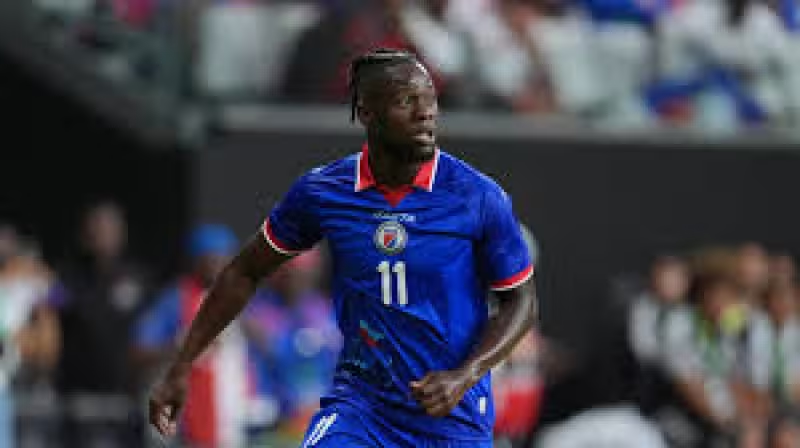
Scott McTominay recovered from a stomach ailment and was back in training on Friday, making him expected to feature for Scotland when they begin their World Cup Group C campaign against Haiti on Saturday night.
McTominay, who flew into Boston from Charlotte, N.C., on a separate flight with a team doctor earlier in the week after falling ill, rejoined teammates at the Revolution Training Center on Friday. Manager Steve Clarke described him as "perfect" and "ready to go" after Friday's session, removing the immediate question over one of Scotland's most influential players.

The scale of the moment is clear: Scotland are playing at the World Cup for the first time in 28 years and open in Boston in a match listed at 02:00 BST; Haiti are back at the finals for the first time since 1974. McTominay has been central to Scotland's return — his bicycle-kick that sealed qualification in a 4-2 win over Denmark last November remains one of the tournament's defining recent images for this squad — and his availability reshapes Steve Clarke's selection decisions ahead of kick-off.
Scotland used a 4-4-2 set-up in a 4-0 warm-up win over Bolivia last week, a game in which John McGinn sat on the bench. Clarke has been clear about the group dynamic: "I’ve got 26 superstars here. To try to put so much onto one person is not fair," he said, adding that the side will need a broad contribution to have a "positive tournament." Captain Andy Robertson echoed that collective line: "We’ve always been a team... Scott has been our lead man the last couple years. I believe anyone in the 26 that gets called upon can produce good moments and great moments."



That unity argument is the counterweight to the selection dilemma. McTominay’s return to training removes the fitness hurdle, but it does not automatically settle the midfield picture. Clarke has emphasised rotation and depth — "It’s going to be a squad World Cup. The starting team is important, [but] I think you’ll find a lot of games the team that finishes the game is every bit as important, if not more important" — leaving open whether he will pair McTominay alongside McGinn, revert to the 4-4-2 used against Bolivia, or tweak the shape to meet Haiti’s strengths.
The week has not been free of fresh concerns. Defender Scott McKenna missed practice because of a leg injury and is listed as questionable for the opener, which could force adjustments at the back if he is unavailable. Those uncertainties increase the value of McTominay’s presence higher up the pitch, where his experience — he moved from Manchester United to Napoli two years ago and has since been a lead figure for his country — can provide a platform to control the midfield and protect any makeshift back line.
There is a practical reading for supporters tuning in: McTominay’s participation should be expected when the teams are named, but the match itself will reveal Clarke’s tactical intent. Will Scotland start with the familiar 4-4-2 and use McTominay as a ball-winning presence ahead of a reshaped midfield, or will Clarke pair him with McGinn from the off and lean on interchangeability? Clarke warned that the game will not be straightforward — "It’s going to be a difficult game. First time in 28 years we’ve been here, first time for Haiti since 1974. They’re also a proud nation. They’re going to be here 100 percent committed, same as we are" — signalling that selection is more than form; it is a response to an opponent expected to arrive fully committed.
The clearest immediate fact is simple: McTominay recovered, travelled with medical support, trained on Friday and has been cleared by Clarke as ready to play. What remains to be seen — and what will decide Scotland’s start to a long-awaited tournament — is how Clarke balances his 26-man squad across the first XI and whether McTominay starts, shares time with McGinn, or is held as a game-changer from the bench.



