



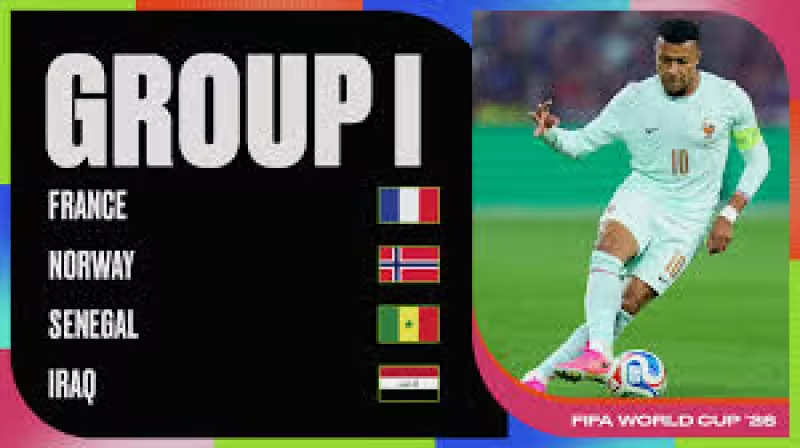
FIFA's men's world rankings are calculated using an Elo-based system that adjusts a nation's points after every match, with bigger stakes and stronger opponents offering more points — a method now central to World Cup Rankings 2026 discussions.
That matters today because the rankings are the baseline for seeding at the 2026 FIFA World Cup: France sit top of the table and England are fourth as the tournament opens, while 40 of the 48 nations taking part rank inside the top 48. Those figures shape who avoids whom in draws and who carries expected status into the group stage.

Under the current rules — in place since the rankings adopted the Elo approach in 2018 — FIFA recalculates points for every international match. The system favors results in more important fixtures and rewards victories over higher-ranked opponents, so every World Cup match will directly alter the lists that determine future seedings and perceptions of team strength.
The raw numbers underline how predictive the list can be: all of the top 11 nations in the men's world rankings qualified for 2026, and 18 of the top 20 made it. At the same time, the tournament includes striking outliers: New Zealand arrive as the lowest-ranked participant at 85th, while debutants Curaçao (82nd) and Haiti (83rd) sit far below most established sides. Regional heavyweights Mexico are 15th, the United States 16th and hosts Canada 30th.


That mix produces immediate practical consequences for tournament organisers and teams. With most qualifiers already inside the top tiers, seeding will reflect existing hierarchies; organisers can use the rankings to assemble pots and manage bracket balance. For teams, defending or improving ranking points becomes a calculable objective: every match offers potential movement under the Elo method, and that movement feeds directly back into future seedings and the narrative around success or failure at this World Cup.
The clear tension is that ranking and qualification do not always line up. Italy, for example, sit 12th in the ranks yet did not qualify for the 2026 tournament; Denmark are 20th and also absent. Both facts expose a contradiction: a system that reliably orders global strength still delivers absent high-ranked teams from the actual competition, changing the pool of seeded sides and creating openings other nations can exploit.
That tension has two immediate effects. First, the absence of high-ranked non-qualifiers inflates the relative status of lower-ranked qualifiers when seeds are drawn. Second, it increases the volatility of what happens next: mid-ranked teams may face easier paths on paper, while debutants and very low-ranked sides such as New Zealand, Curaçao and Haiti can alter perceptions by taking points from higher-ranked opponents.
FIFA will recalculate rankings after every World Cup match, so the tournament itself is both the test and the engine of ranking change. What remains unresolved is the degree of those shifts: the Elo framework describes the mechanism, but not how far any single nation can move during a single tournament. The decisive question for seedings after the event is therefore not whether rankings will change — they will — but by how much, and which teams will convert on the opportunity to leap the established order.



