



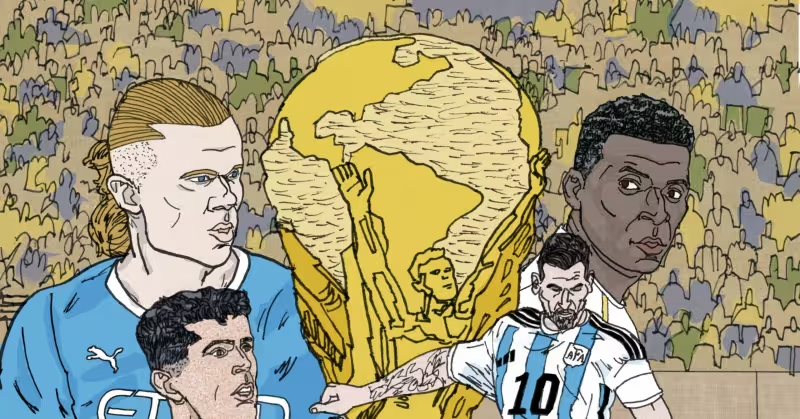
If you’re asking how many teams are in the World Cup, the answer for the 2026 tournament is 48. FIFA expanded the field from 32 to 48 teams, turning the North American tournament into the largest World Cup in history.
The expansion changes immediate stakes: 16 more national sides will play on soccer’s biggest stage, and that includes some of the smallest competitors in the sport. Curacao qualified for the 2026 field and becomes the smallest country ever to reach a World Cup, with a population of about 185,000. Qatar also secured a place in the expanded 2026 field after its difficult debut in 2022, when it failed to pick up any points. Those facts alone frame the scale of the change — more teams, wider representation, and a group stage reworked by numbers.

There are game-level details that make the expansion concrete. Qatar arrives with a clear technical standout: Akram Afif, the team’s primary attacking chance creator and the Golden Boot winner at the 2024 Asian Cup. Curacao, by contrast, brings a markedly different preparation profile; it suffered a heavy 5-1 loss to Australia in March and followed that with a 4-1 defeat to Scotland in May. Those results underline why some national teams will enter 2026 as underdogs and why others hope experienced figures will steady them — Dick Advocaat, at 78, will be the oldest man to manage at a World Cup, adding an uncommon managerial storyline to the tournament.


Context matters here: the tournament will be played across three countries in North America, and FIFA’s decision to expand the roster of entrants is the headline development. The organization framed the enlarged field as a way to open the World Cup to more nations and regions, and the arithmetic is simple: 48 teams create more groups and more matches, transforming the schedule and the mechanics of early-stage qualification inside the event itself.
The critical question, and the tension at the center of every conversation about the expansion, is what it will do to the drama and quality of the group stage. A larger field guarantees novelty — new flags, new fan bases, fresh national narratives — but it also raises the risk of one-sided matches. Curacao’s recent heavy defeats are the clearest example available from qualifying and friendlies; they suggest some expanded slots may produce lopsided scores rather than tight tactical contests. That possibility matters because the group stage is where most viewers decide whether the tournament is compelling.
Practical consequences flow from that tension. Tournament organizers and broadcasters will have more matches to schedule and package, and national teams will confront varied opponents earlier than under the 32-team model. For teams like Qatar, which missed points in 2022 but arrives now with players who have won continental honors, the expansion offers another chance to validate growth. For Curacao, simply qualifying is historic; whether its presence produces competitive matches will be part of the experiment 48-team World Cup immediately becomes.
The unresolved gap after the expansion is straightforward: does adding 16 teams dilute the competitive core of the group stage or broaden the sport without harming its drama? The answer will emerge in results — not abstract argument — and the first signals will come when underdog sides and established nations meet in group play. Observers will watch both scores and stories: whether expanded representation yields memorable upsets and high-quality soccer, or whether it produces more blowouts that flatten the early weeks of the tournament. That uncertainty is the defining question left as the world prepares for the 2026 World Cup across three North American countries.



