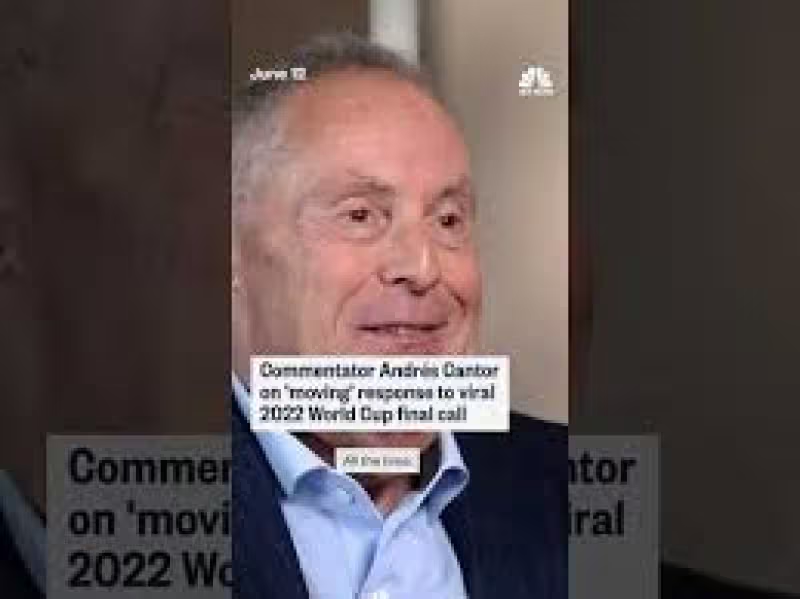
"I wanted to get to the World Cup with the strongest voice possible," Andrés Cantor said, and the sentence lands like a promise before a whistle. The veteran announcer described the work behind that promise — vocal drills, name pronunciation and a regimen he leans on every time the tournament looms.
Cantor framed the preparation as practical and personal. "Before every World Cup, I ask Wendy to get me in shape," he said, without detailing Wendy’s exact methods. That gap is the one practical mystery left in his account: fans now know the outcome he wants, not the recipe that produces it.

The weight of the assignment is easy to measure. Cantor expects a brutal early stretch: "I think I have 10 games in 14 days" in the first round. He also admits the cost. "Obviously, my voice takes a toll," he said, and later added, "When the final whistle blows, I’m pretty much as tired as the players are." The combination of back-to-back broadcasts and travel is a clear test of any announcer’s instrument.
He tied those mechanics back to the moment that made him unmistakable. Cantor traced his big break to the 1994 World Cup, saying, "By yelling the goal the way I yell ‘goal,’ I disrupted the broadcasting world, if you will." The instinctive shout — the one many will write out as "Goooaaalll!" — became a signature, and he called that change "a before and after moment for my career."
Those decades of practice crystallized at the 2022 final, a broadcast Cantor describes as unusually raw. "It was a very emotional and very authentic broadcast because it was just myself on air, and very happy for my home country," he said, noting Argentina beat France on a penalty kick. He said he had been waiting 36 years for Argentina to win another World Cup, and that waiting sharpened his reaction.


Recognition has followed. "It is incredible how many times I’ve been stopped and recognized as the man that made people cry, which is really moving," Cantor said. The line explains why he treats vocal preparation like training for an athlete: the commentary becomes part of a collective memory for viewers and listeners.
Context matters: Cantor is widely associated with that goal call, and he tried to preserve linguistic fidelity when he speaks, saying he articulates players’ last names "as they should be in their native tongue." He also pointed to the setting of this World Cup as a factor in its significance. "I think the FIFA World Cup being played in the U.S. with the amount of Latin American and all immigrants for that matter that already live here, I think it’s going to make this World Cup really extraordinary," he said.
The friction in his account is quiet but persistent. He insisted, "Sleep because sleep for the voice is one of the most important things," then acknowledged the tournament’s grind: game, travel, game, travel. The logic collides — the restorative act he prizes may be the hardest to secure under the schedule he expects.
That collision is the story’s practical stake. Cantor can dial in diction, rehearse the crescendos and protect his throat with warmups, but he cannot manufacture extra hours in a 24‑hour day. He knows the margin for error is slim: a raw voice on a marquee night changes the emotional impact for millions.
The next test is immediate and measurable. Cantor believes the early phase will push him: ten matches across two weeks. Listeners will hear whether the voice that interrupted broadcasting in 1994 and moved viewers in 2022 carries through the onslaught. The unresolved detail — exactly how Wendy gets him World Cup‑ready — is the small, human question that now has to be answered in real time as the tournament unfolds.