



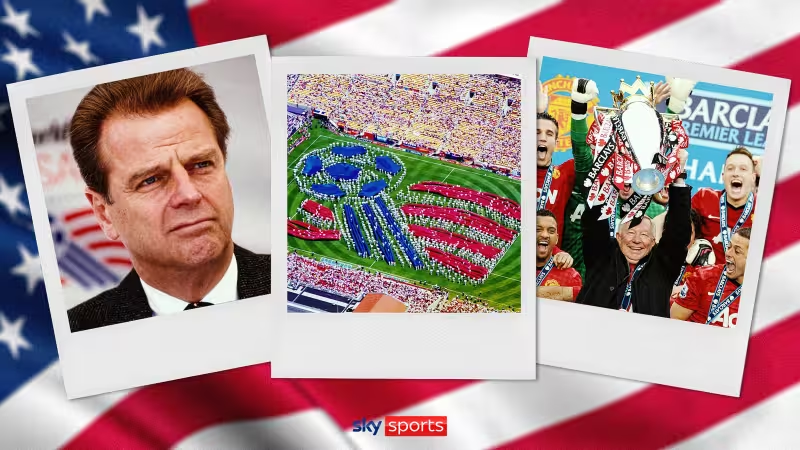
Alan Rothenberg remembers the moment he turned a fragile bid into a national project: he and his six full-time staff hunkered down in a portable cabin in Colorado Springs and launched what he calls a non-stop effort to promote the 1994 World Cup as a must-see event. "So we really embarked on a non-stop effort to promote the World Cup as a big event," Rothenberg said, describing a hands-on campaign that ran from logistics to public persuasion.
Rothenberg was not an outsider handed a ready-made machine. Elected chief of the US Soccer Federation in the summer of 1990, he inherited what he has bluntly called an organisation that "was not professionally managed; it was essentially a volunteer organisation." FIFA had asked him to run so he could step in and take over World Cup preparations, and with that backing he defeated Werner Fricker to lead the USSF and its World Cup task force.

The scale of the challenge was concrete. The United States had been chosen to host the tournament over Brazil and Morocco, yet the country had no top-flight domestic league for five years after the demise of the NASL and the national team had missed nine of the previous 10 World Cups. Rothenberg framed the work ahead not as routine event management but as a campaign to change habits. "My vision, if you will, all surrounded that. The inspiration was to convince the American public that this was an event they couldn't miss," he said, and he tied success to measurable outcomes: "And if we do that, we'll be successful in creating a lot of enthusiasm and, ultimately, big attendances and large revenues."

Rothenberg leaned on what he learned at the Los Angeles Olympics a decade earlier. "I'd been fortunate enough to be deeply involved in the 1984 Olympics in Los Angeles," he said, adding that those Games proved a central lesson: "It was clear to me from those Games, and other sporting tournaments, that Americans love a big event." The Olympics had shown how a concentrated, high-profile presentation could alter public attention; Rothenberg set out to replicate that effect for the World Cup.
Not everyone agreed that the United States was fertile ground for world football. Rothenberg recalled a blunt comparison — "Taking the World Cup to the United States is like taking the World Series to Brazil" — a line that captures the skepticism he faced from inside the sport and beyond. That contrast between international expectations and domestic reality became the friction at the heart of his brief: could a country without a strong professional league and with limited recent World Cup pedigree be persuaded to treat the tournament as indispensable?
The method was relentless promotion. Working from a small headquarters and with a skeleton staff, Rothenberg pursued a broad campaign to generate attention on television, in stadiums and through civic partners, betting that visible spectacle would translate into the large attendances and revenues he sought. The gamble paid off in one clear way: the tournament went ahead in 1994, played in the United States. Over the longer sweep, football in the country has risen; a recent survey cited by The Economist found the sport overtook baseball for the first time to become the USA's third-most loved sport, a shift that aligns with the broader trajectory Rothenberg hoped to start.
But the clean line from one campaign to a generational change in sporting preference does not exist in the record. Rothenberg’s hands-on strategy and his decision to present the 1994 World Cup as an American spectacle are central facts; how much of football’s rise in the United States can be directly traced back to that campaign remains unresolved. The more immediate, provable consequence is institutional: a largely volunteer federation was refocused into a professional drive to stage a single, visible event—an experiment in turning exposure into enduring interest whose precise contribution to today's audience for the sport is still the question left hanging over Rothenberg’s legacy.



