




Lionel Messi’s arrival in Major League Soccer has done more than boost ticket sales: Inter Miami’s signing of the superstar has prompted MLS owners and the league office to reopen a long-settled debate over whether the league’s single‑entity business model needs to be altered for the next era.
Paul Tenorio’s new book, THE MESSI EFFECT: A Global Legend’s Last Act and American Soccer’s New Beginning, frames Messi’s signing as a turning point — “charting a new course for MLS” and accelerating conversations that had been theoretical for years. The urgency was immediate: the day after Messi walked onto a rain‑slicked stage, Mas boarded a jet to Washington, DC, to attend an MLS board meeting, a clear sign owners treated the move as more than a marketing moment.

The league’s current structure traces to MLS’s founding in 1993, a condition tied to the United States hosting the 1994 World Cup. Former MLS deputy commissioner Mark Abbott drafted a sixty‑nine‑page plan that reflected U.S. Soccer president Alan Rothenberg’s approach: a single‑entity league in which owner/operators compete on the field but act as partners off it. Under that design, owners own a percentage of MLS rather than only an individual franchise; the league office controls player contracts and centralizes cost and revenue sharing.
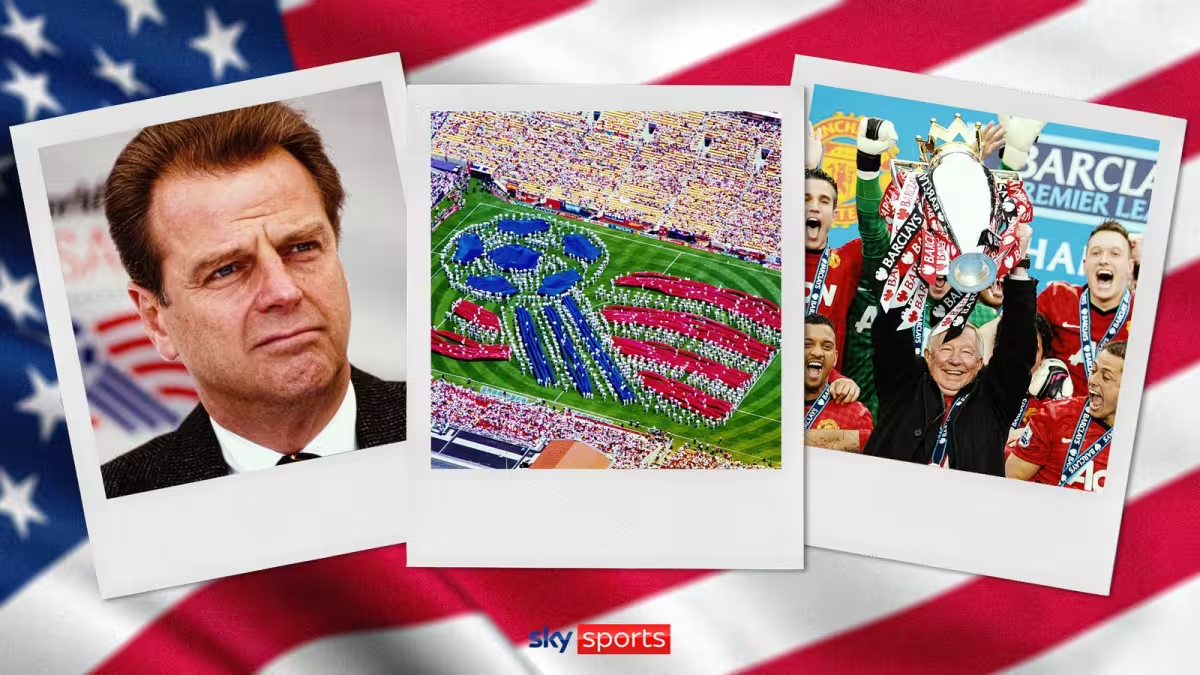
Abbott has defended that choice as necessary to avoid the boom‑and‑bust that sank the North American Soccer League in the 1970s and 1980s, even though NASL once filled stadiums with Pelé, Franz Beckenbauer, Johan Cruyff and George Best. "We thought that was critical, given the fact that soccer had failed before, to be able to have that stability," Abbott said. "When you have an unstable league, even the strong teams go out of business if the weak teams ultimately go out of business. So it's the only business in the world where you don't want your competitor to go out of business, right?" Three decades after MLS’s founding, that single‑entity model is widely credited with keeping the league financially solid.
Messi’s arrival exposed the tension beneath that stability. The player’s commercial power and draw have magnified questions about competitive balance — long a foundational mandate for MLS — and whether strict central control remains the best way to manage superstars whose value can dwarf the system. Owners now face a tradeoff: preserve the shared, centralized controls that limited risk for 30 years, or allow more franchise autonomy to capture and allocate the outsized returns a player like Messi generates.
The debate is practical, not purely philosophical. Changes to the single‑entity framework would touch the mechanics that have defined MLS finance and roster building: how player contracts are negotiated, how costs and revenues are split, and how individual clubs can invest. Those are exactly the levers the original plan centralized to prevent the kind of overspending and collapse seen in earlier U.S. soccer history. The book argues Messi’s signing heralded the beginning of a new era; what that era requires in governance is the subject of the current boardroom argument.
For now, the league has its stability and a warning. Messi has shown MLS the scale of opportunity and the scale of pressure on its rules. Owners rushed to Washington, DC, but left without a documented overhaul; Mas’s trip was presented as urgent, not decisive. The single most consequential unanswered question now is specific: will owners be willing to loosen league control over player contracts and revenue allocation enough to give individual franchises greater autonomy — and, if so, how much of the single‑entity framework will they be prepared to unpick?



