Elon Musk became the world’s first trillionaire Friday when SpaceX went public, based on the company’s projected IPO valuation of $1.77 trillion.
That single figure is why the market has been talking nonstop: $1.77 trillion is nearly ten times the valuation of Alibaba at its 2014 U.S. debut and roughly double the valuations hovering around $900 billion for both OpenAI and Anthropic. One trillion, remember, equals 1,000 billion; a $1.77 trillion price tag pushes corporate math into territory almost no public company has occupied before.

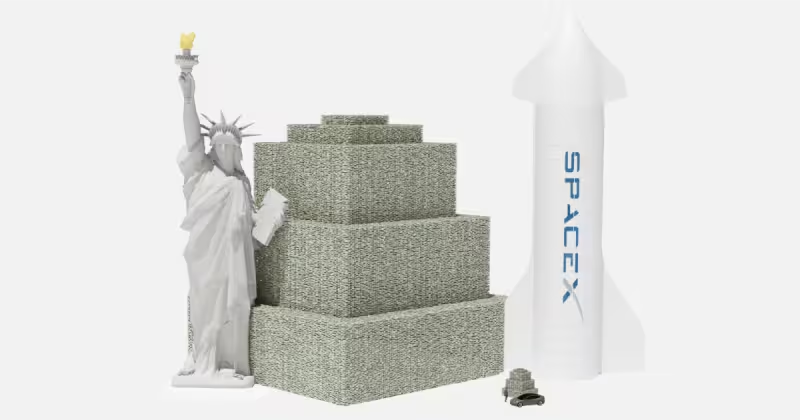
Put another way, the numbers jump out when you translate them into things people can picture. A stack of $100 bills worth $1 million stands just over three feet tall. A stack worth $1 billion is over half a mile. A stack worth $1 trillion reaches 679 miles — nearly 11 times the distance from Earth’s surface to the edge of outer space. A $1 trillion pile of $1 million bundles would rival the Statue of Liberty and be almost as tall as SpaceX’s Starship. Musk’s trillion could buy 8,880 Boeing 737s or buy the New York Knicks 102 times over.
Those visual comparisons help explain why lists of the richest people in the world suddenly include a new threshold. They also expose a cognitive gap. Google’s data, which tracks word usage across millions of books, shows references to the word “trillion” remained scarce until after World War II. John Allen Paulos, who wrote in 1988 that humans are especially bad at reasoning about very large numbers, put it plainly: "Up until relatively recently, we had no real reason to talk about such numbers." He added, "So it’s not surprising that they don’t make much sense to people."



There is an equally sharp contradiction in the facts. Trillion-dollar valuations are becoming thinkable — the $900 billion marks for AI companies and SpaceX’s $1.77 trillion projection show that — but the historical record shows such numbers were rare and hard to map onto real-world experience. Alibaba’s 2014 IPO remains the highest valuation ever recorded in the United States, and until now corporate and personal fortunes were measured in billions: Tesla’s IPO valuation, for instance, was roughly $1.7 billion more than 15 years ago, not trillions.
The friction matters because headline labels — "first trillionaire" — rest on market math, not yet on a clear ledger of what Musk actually owns once SpaceX is public. The publicized valuation creates that headline, but the exact public-offering terms and the ownership details that produced Musk’s trillionaire status have not been disclosed in the material used here. That gap matters for how permanent the label will prove and for how rankings of the richest people in the world are calculated going forward.
Beyond headline politics, the practical consequences are striking. For an average U.S. household earning almost $84,000 a year, it would take nearly 12 million years to accumulate a trillion dollars. If a person spent $1 million a day, it would take 2,740 years to spend $1 trillion. Simple timelines underline the absurd scale: a million seconds in the past is less than two weeks ago; a billion seconds puts you back to 1994; a trillion seconds reaches roughly 29,000 B.C.
Those comparisons make Musk’s new place atop wealth charts feel both concrete and surreal. They also clarify why the conversation about how many "richest people in the world" can reach trillion-dollar levels is not merely semantic: corporate valuations drifting into the trillions will recast wealth lists, regulatory attention, and market psychology the same way earlier leaps — from millions to billions — did.
The single most consequential unanswered question now is straightforward: what do SpaceX’s final offering terms and the public market’s first days of trading say about the firm’s $1.77 trillion valuation and Musk’s stake in it? Until those figures are published and markets put a price on shares in hand, the trillionaire label rests on projected value rather than the full accounting a public filing would provide. If the valuation holds, the benchmark for the richest people in the world has changed; if it does not, the math that put a trillion into common conversation will have been provisional, not permanent.