



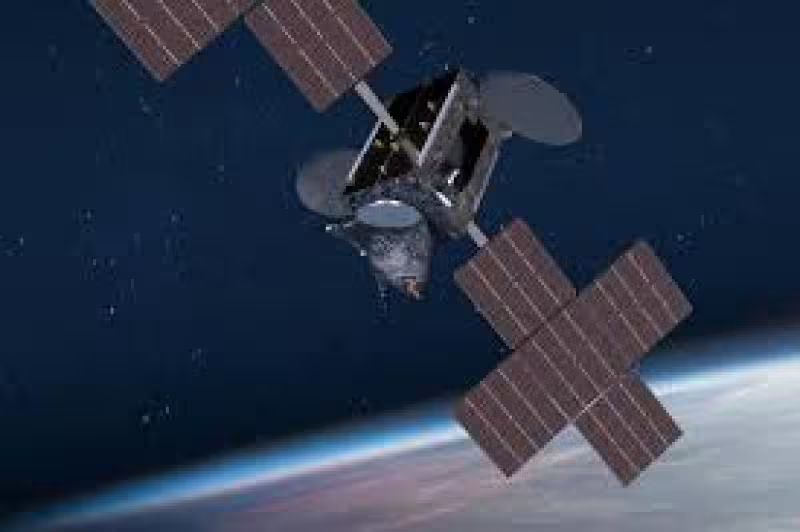
EchoStar shares closed nearly 11% higher on Thursday and were up about 5% after hours as investors piled into what many view as a direct public-market proxy for SpaceX ahead of the rocket company’s Nasdaq debut on Friday.
The move ties back to a spectrum sale first announced in September 2025 and later expanded in November 2025. Under the original deal EchoStar agreed to sell spectrum to SpaceX for roughly $17 billion — structured as up to $8.5 billion in cash and up to $8.5 billion in SpaceX Class A common stock — and the amended agreement raised total consideration to about $19.6 billion, including up to roughly $11.1 billion to be paid in SpaceX stock priced then at $212 a share.

Barron’s has estimated EchoStar stands to receive roughly 52 million SpaceX shares from that arrangement, a figure investors have seized on as SpaceX set its IPO price at $135 per share, selling 555.6 million shares and raising a record $75 billion that values the company at about $1.77 trillion.
The market reaction was visible beyond EchoStar’s quote: retail sentiment around SATS stock jumped from bullish to extremely bullish over the past 24 hours on Stocktwits, illustrating how traders are treating EchoStar as a vehicle for exposure to SpaceX before the latter begins trading on Nasdaq on Friday.



Those bets come despite clear strain inside EchoStar’s legacy operations. In the first quarter of 2026 EchoStar lost roughly 366,000 net pay‑TV subscribers and ended the quarter with 6.63 million total pay‑TV subscribers; pay‑TV revenue fell 10% year‑over‑year. HughesNet also lost about 58,000 subscribers, and consolidated revenue slipped 5.2% to $3.67 billion, though EchoStar narrowed its net loss to $146.9 million from $202.7 million.
The tension for investors is straightforward: the surge is being driven by the SpaceX connection — and specifically the stock component of the spectrum deal — even as EchoStar’s core satellite and pay‑TV businesses show deteriorating subscriber and revenue trends. That mismatch raises questions about how durable any premium for EchoStar will be once SpaceX begins trading and the market prices EchoStar’s expected stock holding more precisely.
Complicating the picture is that the amended agreement used a $212 per‑share valuation for SpaceX stock, while the IPO was priced at $135. The difference between the deal’s internal valuation and the IPO price leaves an open accounting and market‑pricing gap that traders and analysts will watch closely once SpaceX shares begin trading on Nasdaq on Friday.
The immediate next data point is clear: SpaceX starts trading Friday, and EchoStar shareholders will be watching whether EchoStar’s stock continues to move in step with the new market price for SpaceX or re-rates once the actual value of the stock consideration is marked to market. That question — how closely EchoStar will track SpaceX once trading begins — is the single most consequential unknown left hanging after Thursday’s rally.
“Anan Ashraf has no position in any of the stocks mentioned in this article.”



