



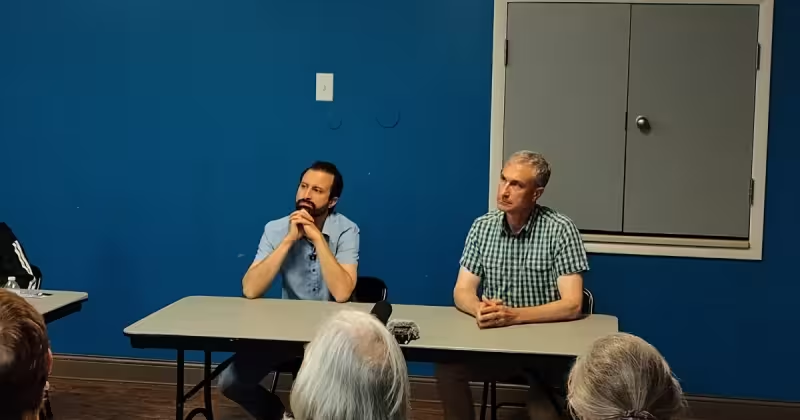
“He doesn’t like how DTE operates but taking it over would be cost-prohibitive,” Christopher Taylor told roughly 60 residents at a Monday night debate, drawing a clear line between his skepticism about the utility and the price of trying to replace it.
The exchange with fellow candidate Yousef Rabhi at the Arrowwood Hills Community Center was the sharpest divide of the evening: Taylor framed the municipal‑utility question as a practical, budgetary barrier; Rabhi framed it as a civic choice. “Ann Arbor needs to reject the philosophy of what can’t be done and take on DTE directly,” Rabhi answered, pressing a more aggressive, possibility‑driven approach.

About 60 people filled the community center for the debate, which followed a familiar local campaign script — candidates answering questions from residents on housing, bike lanes and police‑community relations — but the municipal utility proposal dominated headlines and the room’s attention.
The contest over DTE was not abstract. Both candidates acknowledged the company by name; Taylor’s comment acknowledged a long‑running local frustration with the utility’s operations but stopped short of endorsing an attempt to create a city‑owned system. Rabhi’s retort put voters on notice that he would favor a direct municipal challenge to the status quo rather than accepting what he called a default of impossibility.
That split — caution versus confrontation — framed the evening. Taylor’s cost‑focused stance suggests a mayoralty that would prioritize financial feasibility and risk avoidance in any study or pursuit of a city utility; Rabhi’s posture suggests an administration willing to pursue aggressive, city‑led remedies to a regional utility’s policies even if the path is difficult.
Other issues at the forum were conventional campaign fodder: housing pressures, where candidates debated local policy responses; bike lanes, where tradeoffs of safety and street design surfaced; and police‑community relations, where both candidates faced pointed questions from attendees. None of those topics produced the same binary choice about whether the city should weigh a municipal takeover of electric service.
The debate left the central practical question unanswered: how much would it cost Ann Arbor to create or take over a municipal utility? Taylor’s contention that takeover would be “cost‑prohibitive” and Rabhi’s insistence that the city must “reject the philosophy of what can’t be done” both sharpen the stakes, but neither side offered a figure or study at the event to convert principle into budget reality.
For voters, the split boils down to priorities. Taylor’s line, repeated to the packed room, is a cautionary one aimed at keeping the city’s balance sheet and risk exposure front and center. Rabhi’s line is an argument about municipal will: if the community prioritizes a public alternative, he said, the city should mobilize to confront DTE. The debate made clear that residents will be choosing between those two logics, not simply between personalities.
The most consequential unanswered question from Monday night is exactly the one both candidates raised from opposite directions: what would a municipal challenge to DTE cost Ann Arbor, and who would pay for it? The debate forced the candidates to stake competing philosophies, but it left voters with the practical gap between ambition and affordability — a question that will shape any move forward on a city utility and that neither candidate closed before the audience filed out of the Arrowwood Hills Community Center.



