




Investors enter the week of June 8-12 focused on two inflation prints: the May CPI due Wednesday and the PPI due Thursday, with the Cleveland Fed’s nowcast pointing to a 0.46% month‑over‑month rise in headline CPI and a 4.18% year‑over‑year rate, up from 3.8% in April.
The Cleveland Fed model also projects core CPI up 0.23% m/m and 2.82% y/y, a small step above April’s 2.80% reading. Those nowcasts sit alongside April’s PPI Final Demand already at 6.0% y/y, a reminder that producer prices remain elevated even as the composite ISM Prices‑Paid Index eased to 153.4 in May from 155.3 in April.

That mix — a nowcast showing a notable month for consumer prices and an expensive producer‑price backdrop — is why markets are watching closely. The week begins with the New York Fed’s consumer inflation expectations survey on Monday and ends with the University of Michigan’s preliminary June sentiment release on Friday, giving traders a continuous string of inflation and confidence data to parse before the weekend.
Labor market readings add friction. A strong May payrolls gain of 172,000 has already increased the odds of a Federal Reserve rate hike in coming months, even as long‑term inflation expectations appear relatively anchored. In April’s Survey of Consumer Expectations, the median one‑year‑ahead outlook was 3.6%, three‑year at 3.2% and five‑year at 3.0%, while the University of Michigan’s May survey showed a one‑year‑ahead expectation of 4.8% — a divergence that keeps the policy debate alive.


Other high‑frequency data offer a mixed signal: initial jobless claims for the week of May 29 were 225,000 and the four‑week moving average ticked up to 214,800, suggesting hiring remains resilient. Consumer mood, meanwhile, was weak in May — final University of Michigan sentiment fell to 44.8, with the current conditions index at 45.8 and the expectations index at 44.1 — a backdrop that could temper the spending response if prices surprise to the upside.
Global price threads matter, too. China’s CPI rose 1.2% y/y in April and its PPI climbed 2.8% that month; Japan’s PPI accelerated to 4.9% y/y in April. Domestically, retail gasoline averaged $4.44 per gallon on June 1, after futures moved down from earlier highs. Those external and energy inputs help explain why a domestic CPI gain could look larger in headline terms even as core measures remain more subdued.
The practical market question is straightforward: will Wednesday’s CPI and Thursday’s PPI be strong enough to force a material repricing of Fed policy? April’s 6.0% y/y PPI and the Cleveland Fed’s hotter May nowcast argue the risk is real. Traders will use the New York Fed and Michigan survey releases as crosschecks on how entrenched those price moves might be in consumer expectations.
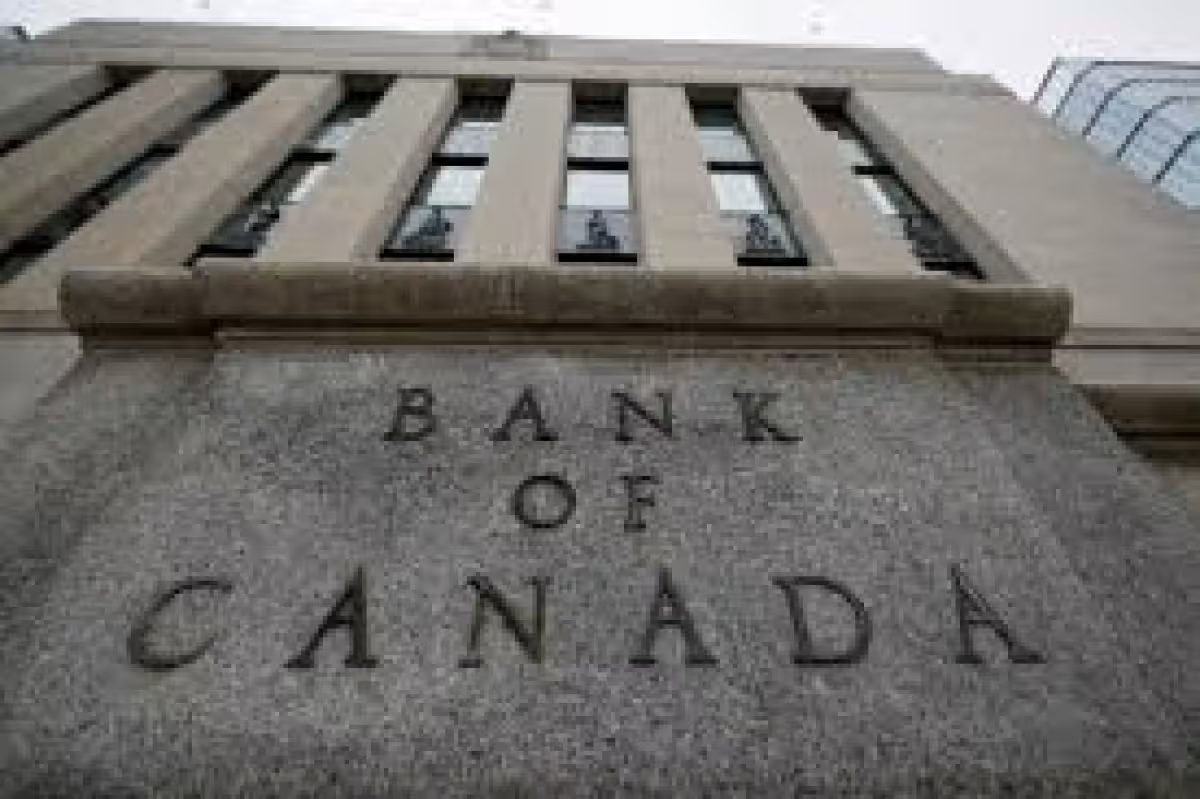
Monetary policy calendars complicate the backdrop. The Bank of Canada meets on Wednesday and is expected to hold its overnight rate at 2.25%, a reminder that other central banks are watching similar signals even as attention centers on U.S. data. And markets will not be able to ignore company news: SpaceX’s IPO is expected to keep headlines buzzing, with the stock set to begin trading on Friday.
What comes next is the decisive test: if CPI and PPI mirror the Cleveland Fed nowcast and April’s PPI strength, market odds of additional Fed tightening will rise materially; if they come in softer, the payrolls print that raised short‑term odds may prove an isolated signal. The coming five days will tell whether inflation readings push the narrative toward renewed policy action or simply reinforce the view that longer‑run inflation expectations remain anchored.



