



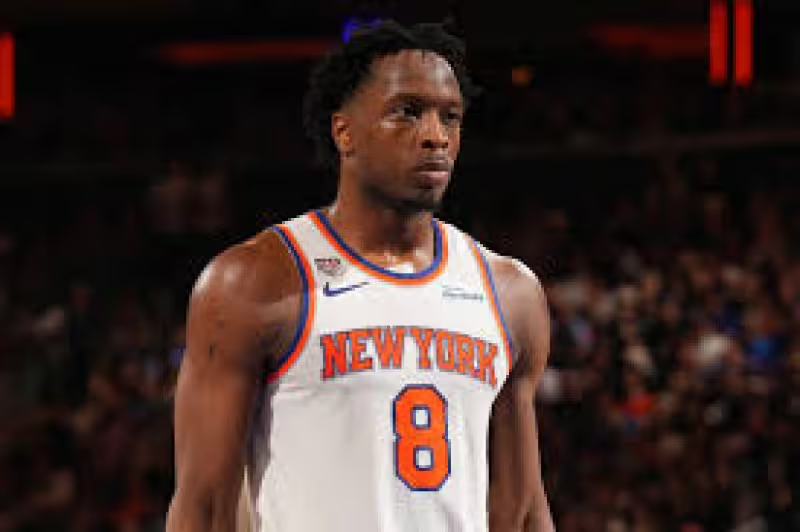
When OG Anunoby was a boy in Jefferson City, Missouri, his father insisted on two rules: an hour of reading every night and a promise to actually use the backyard basketball hoop. "I said to him, 'You have to promise to actually use it. You will make sure that we have value for money,'" Ogugua Chigbogu Damian Anunoby Sr. told family and friends, insisting academics and effort mattered as much as athletic promise.
That dual demand—literacy and a relentless work ethic—follows Anunoby to the 2026 NBA Finals, where he helped the Knicks reach the league’s championship series. The routines his father established are the clearest through-line between a small, disciplined household and a player now on basketball’s biggest stage.

OG Anunoby was born July 17, 1997, to Nigerian parents Ogugua Chigbogu Damian Anunoby Sr. and Grace Ndidi Okereke. Grace died of cancer in 1998 when he was 1 year old; her athletic legacy lived on in the family—Ogugua Sr. described her as "a sprinter, she was a jumper — she was very competitive." The father who raised him alone combined that pedigree with a rigorous academic creed: he earned degrees from the University of Nigeria, the University of Strathclyde, the University of Glasgow and a Ph.D. from Brunel University of London before joining Lincoln University in 2001, where he taught until his death in 2018.
The numbers underline the influence: seven children, a professor father who served at Lincoln University from 2001 to 2018, and a household in Jefferson City where a 12-foot adjustable hoop sat in the backyard and a small boy showed early athletic versatility—pitching on the baseball diamond before focusing on basketball. OG has said plainly of his childhood, "It was tough not having a mother, but my dad did a really good job raising us." That assessment stitches together absence and instruction: a single parent filling two roles and pressing for order.
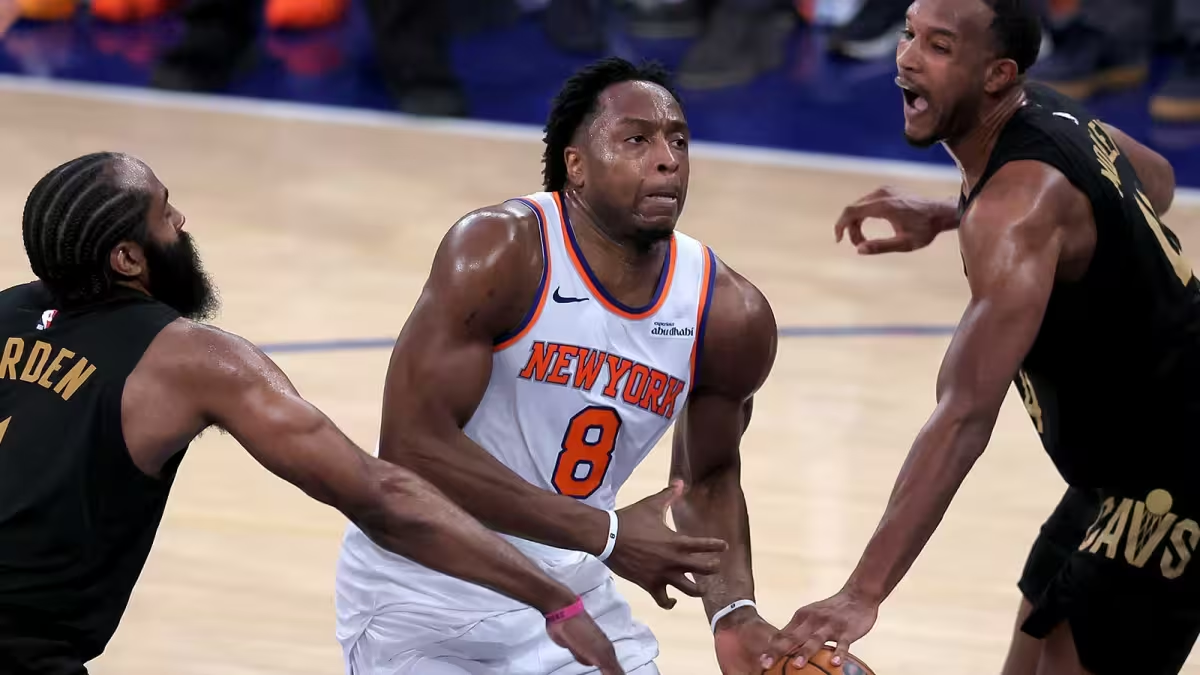

Education and restraint were part of the Anunoby brand. Ogugua Sr. spoke in values: "I do not intend to be immodest, but we tried to raise a proper family," he said, explaining that proper meant doing things well, valuing hard work, order and success. Rules about speech—"You don't talk unless you have to talk"—and the nightly hour of reading were not window dressing. They were daily practices meant to reshape what a small-town childhood might yield.
Athletics ran alongside. Grace Ndidi Okereke had been a national track-and-field competitor; an older brother, Chigbo, later played defensive tackle at Morehouse College and signed with the Indianapolis Colts as an undrafted free agent in 2012. OG’s early life included baseball and a childhood wish for a serious hoop; his father encouraged those pursuits rather than deferred them in favor of academics alone.
There is, however, an unresolved part of the story. Ogugua Sr. died in 2018, and public accounts catalogue his life and the household rules he imposed but stop short of explaining the decade that followed inside the Anunoby home. Who carried the evening rituals after 2018? How did the loss of both parents—his mother in 1998 and his father in 2018—reshape the daily scaffolding that produced an NBA starter? Profileing his early life illuminates the toolkit he inherited; it does not show how those tools were wielded once the professor was gone.
That gap matters because it is where the private steadying force becomes a public narrative. Anunoby’s play, his measured temperament, his willingness to defend and do the unglamorous work on a Finals roster are visible echoes of a household that prized order and contribution. Still, the single most consequential unanswered question is how those household routines were sustained or transformed after Ogugua Sr.'s death—an explanation that would close the line from a professor’s reading hour to the habits of an NBA finalist.
As Anunoby prepares for each game in the Finals, he carries his parents’ legacies in different ways: a mother who was a competitive athlete, and a father who combined scholarship and discipline. The public record outlines what he inherited; it stops short of mapping the intervening years. If the Finals provide anything beyond sport, it may be the moment he chooses to explain how the early demands of Jefferson City became the daily practice of a championship-level player.



