



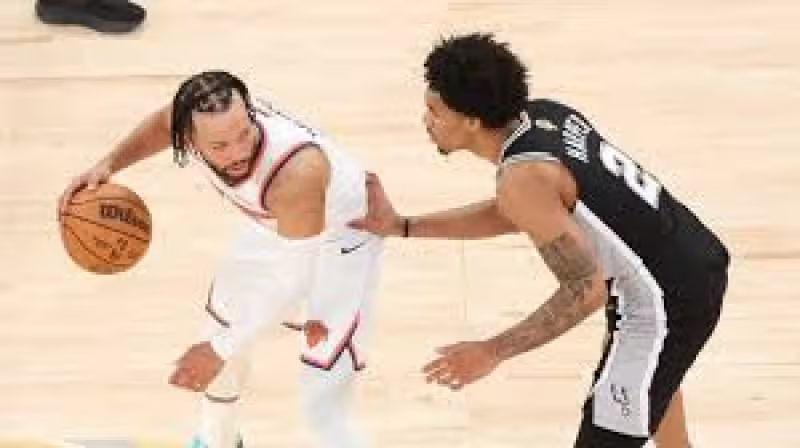
NBA.com writers laid out the matchup edges ahead of Finals Game 4 scheduled for Wednesday in New York, pinning San Antonio’s upside to Victor Wembanyama and New York’s to a rest-and-depth advantage that could reshape the series.
The clearest proof point for the Spurs is Wembanyama’s steady climb through the first three games: 26 points in Game 1, 29 in Game 2 and 32 in Game 3, with field-goal percentage rising from 28.6% to 52.4% to 61.1%. His 3-point accuracy climbed from 22.2% to 33.3% to 50%, and he has hit two 3-pointers in each Finals game while trimming attempts from nine to six to four. Wembanyama’s plus/minus has flipped from minus-3 in Game 1 to plus-6 in Game 2 and plus-7 in Game 3, and his turnovers have come down dramatically — only one in San Antonio’s Game 3 win after committing 10 turnovers earlier in San Antonio.

New York’s counterpunch is less dramatic on the box score and more structural. The Knicks had won 13 consecutive playoff games before their Game 3 defeat, a loss that league writers framed as the franchise’s biggest advantage heading into Game 4 because it forced correction. New York has played four fewer games and nearly 200 fewer minutes this postseason than the Spurs — 821 minutes versus San Antonio’s 1,018 — and that fresher ledger is reinforced by a deeper rotation: nine Knicks are averaging 10 or more minutes per game versus seven for the Spurs, and New York’s reserves have outscored San Antonio’s 77-64 through three games.

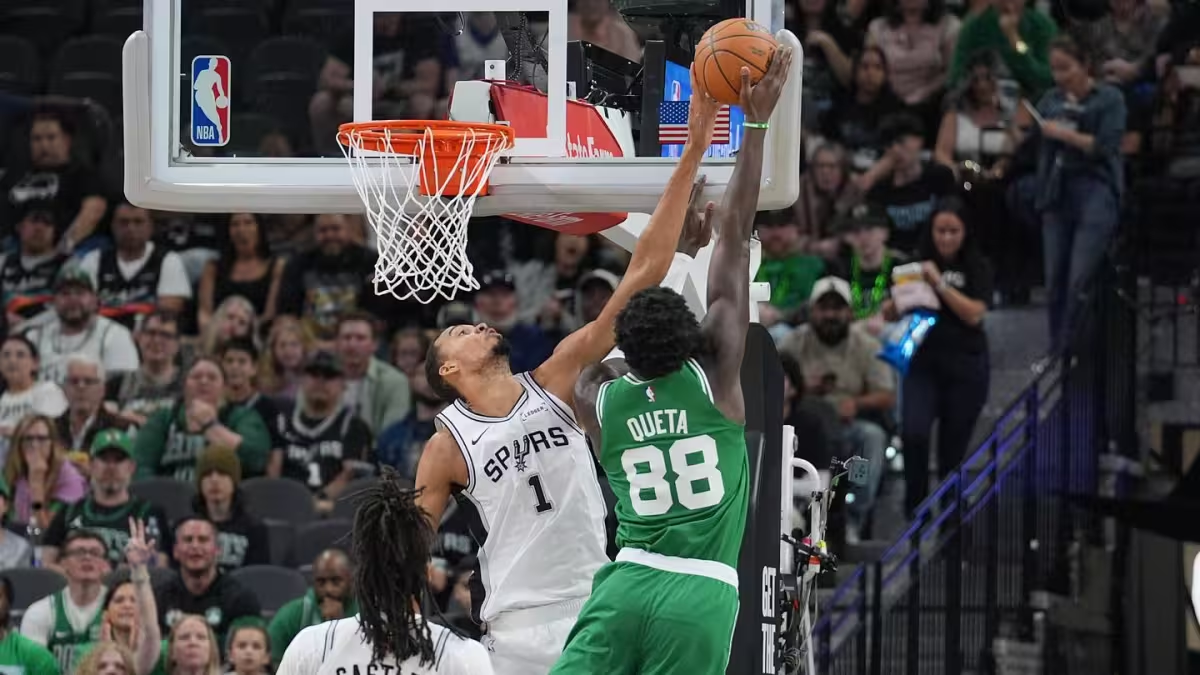
Context sharpens those edges. The Spurs were stretched in the playoffs, needing six games in one round and seven in another, while New York swept the past two rounds before the Finals. That heavier workload helps explain why San Antonio leaned on its defensive pressure in Game 3, with guards Stephon Castle and Dylan Harper forcing Jalen Brunson to work harder on offense — a level of attention comparable to the pressure San Antonio applied to Shai Gilgeous-Alexander in the Western Conference Finals.
Where the matchup will be decided comes down to two linked threads the numbers expose: can Wembanyama sustain his rising efficiency while staying careful with the ball, and can the Knicks’ deeper, fresher rotation convert its bench scoring edge into game-long resistance? Practically, watch Wembanyama’s shot profile early — his three-point attempts have declined each game even as his accuracy climbed — and notice how often San Antonio’s guards make Brunson alter his reads. Those moments will reveal whether the Spurs’ defensive game plan creates enough disruption to blunt New York’s depth.
The friction is obvious: New York’s supposed advantage is that it lost Game 3, a correction opportunity rather than momentum. That makes tonight’s matchup less about narrative and more about execution. If the Knicks use their extra rest and rotation to keep Brunson effective without letting Wembanyama get comfortable, Game 4 could tilt home. If Wembanyama’s efficiency holds and San Antonio’s backcourt pressure continues to force extra work from Brunson, the Spurs will keep the series within reach.
The single consequential question left unanswered as tipoff approaches is whether New York’s rest and rotation will actually translate into stopping San Antonio’s ascending star — a binary that will determine whether Game 4 renews the Knicks’ sweep-like momentum or hands the Spurs the leverage of a series reset.



