



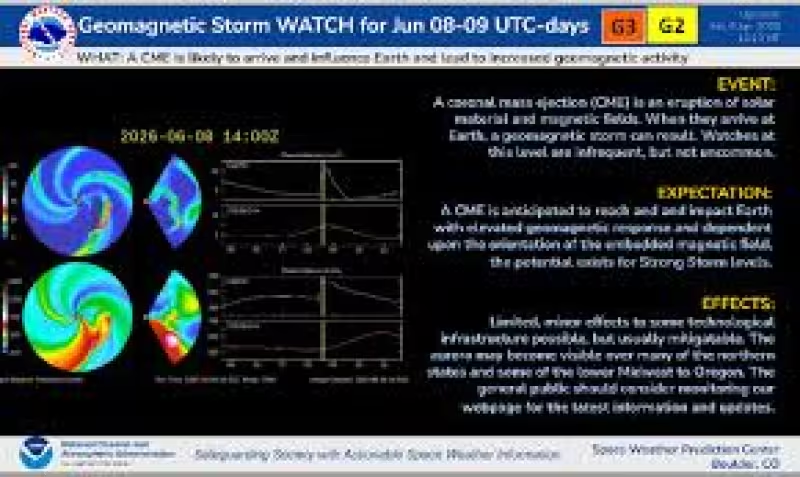
NOAA’s Space Weather Prediction Center issued a G3 geomagnetic storm watch for 8 Jun and followed with a G2 geomagnetic storm watch for 9 Jun tied to a coronal mass ejection that left the Sun on 6 Jun. The two-day sequence — stronger alert first, lower one day later — frames the agency’s expectation that conditions favorable for geomagnetic activity will span both dates.
The notice names the event: a CME departed the Sun on 6 Jun and is the anticipated trigger for the watches. The agency published the bulletin and closed its advisory with a single, direct line: "Stay tuned for updates!" That line is the operational instruction: NOAA expects the situation to evolve and will revise its watches if observations change.

Put simply, a G3 watch for 8 Jun followed by a G2 for 9 Jun signals a short-lived peak in forecasted disturbance. The numeric labels are the explicit facts: G3 on 8 Jun, G2 on 9 Jun. Together they tell readers that the panel expects the most intense effects — whatever form they take — to be concentrated on the first day, with activity diminishing the next.

How the sequence came about remains unspecified in the notice. The published timeline is the only timing detail provided: 6 Jun — CME departure from the Sun; 8 Jun — G3 watch; 9 Jun — G2 watch. The bulletin does not say when the CME is expected to arrive at Earth, nor does it identify geographic regions where impacts would be greatest. That gap is the immediate practical question for anyone tracking potential aurora or space-weather impacts.
The friction is simple and consequential: NOAA put the stronger watch on the first day, then a lower-level watch on the following day. Forecast products often show a rise and fall as a CME’s leading edge and subsequent flows pass by; the notice confirms only that the agency expects elevated geomagnetic activity on both 8 Jun and 9 Jun. Without an arrival window or regional guidance in the text, readers must treat the two watches as a blanket advisory that conditions could change quickly.
For people following the phrase NOAA June 8 CME aurora, the immediate takeaways are the dates and the origin: a CME left the Sun on 6 Jun and the Space Weather Prediction Center has set watches for 8 and 9 Jun. The agency’s wording — again, "Stay tuned for updates!" — is the practical directive embedded in the bulletin. Any more specific guidance will have to wait for follow-up notices or real-time observational reports.
The single most consequential unanswered question is also the clearest: when will the CME reach Earth and which areas will see the greatest effects? NOAA’s two-day watch pattern points to a brief peak followed by a taper, but the notice contains no arrival timestamp and no geographic breakdown. Expect the agency to publish updates; until it does, the watches stand as the definitive, time-specific signal that geomagnetic conditions warrant close monitoring on 8 Jun and 9 Jun.



