



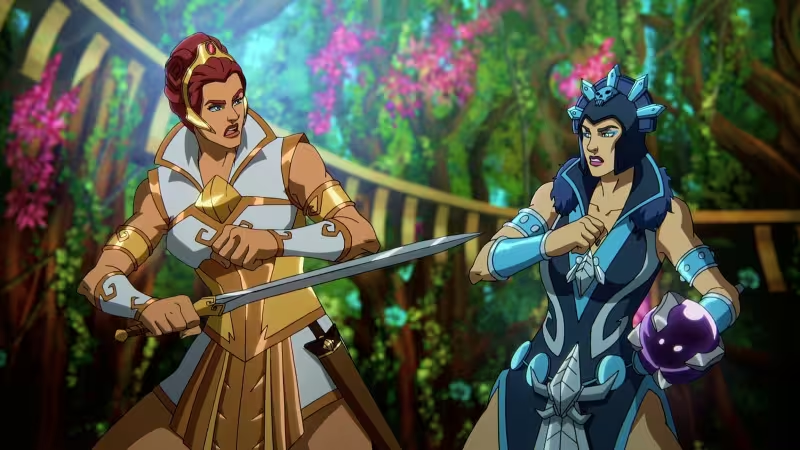
Kevin Smith’s animated revival of Masters of the Universe landed on Netflix in July 2021 and, across Revelation Part 1 and Part 2 and the 2024 follow-up Revolution, produced three releases that together averaged 95% on Rotten Tomatoes.
The sequence began when Masters of the Universe: Revelation Part 1 debuted on Netflix in July 2021, followed by Part 2 in November 2021, and continued with Masters of the Universe: Revolution in January 2024; Revelation itself was presented as a 10-episode series. The project was created by Kevin Smith and produced with animated visuals by Powerhouse Animation, and it featured an expansive voice cast including Sarah Michelle Gellar, Melissa Benoist, Liam Cunningham, Griffin Newman, Stephen Root, Chris Wood, Mark Hamill, Lena Headey, Kevin Conroy, Tony Todd, Tiffany Smith and William Shatner.

The verdict from critics was decisive: the three releases together registered a 95% average on Rotten Tomatoes, a figure that frames the revival as one of the franchise’s most broadly praised modern entries. That metric became the clearest signal that a project billed as a mature reboot had won professional validators even as it retooled decades‑old characters and mythlines.
That critical success matters now because the franchise is shifting back toward theaters; the property is about to return to the big screen for the first time in almost 40 years with a new live‑action movie, and the animated revival functions both as a continuation for longtime followers and as an accessible entry point for newcomers who discover the franchise on Netflix.
Context helps explain the arc: Smith framed the animated series as a sequel to He‑Man and the Masters of the Universe while also leaning into a darker, more expansive take on the lore. Powerhouse Animation’s visuals and the A‑list voice roster gave the project production heft that supported a claim it could serve new audiences unfamiliar with the original cartoon while satisfying fans who wanted stakes and continuity.
That claim was not uncontested. The revival’s narrative choices sparked controversy when it debuted, with some viewers objecting to particular plot directions even as critics ultimately embraced the show. The split between audience debate and aggregated critical praise is the story’s friction point: a project that reconfigured established characters drew vociferous early pushback but still reached an unusually high critical plateau.
What changes next is the key unresolved question. Netflix has not confirmed an official ending for the animated saga, leaving the series’ long‑term status open even as the franchise pivots back to theatrical release. The theatrical move complicates the future: the animated revival stands as a completed creative statement across its three releases and a clear gateway for new fans, but without a formal Netflix coda the possibility of more animated entries — or of the stream courting continuity with the upcoming live‑action movie — remains unanswered.
Given those facts, the clearest conclusion is simple: Kevin Smith’s Netflix revival has already reshaped how Masters of the Universe is judged in the 21st century — critically validated and narratively ambitious — yet its final chapter is still unwritten, because Netflix has not declared the animated saga finished even as the franchise bows back into theaters after nearly four decades.



