



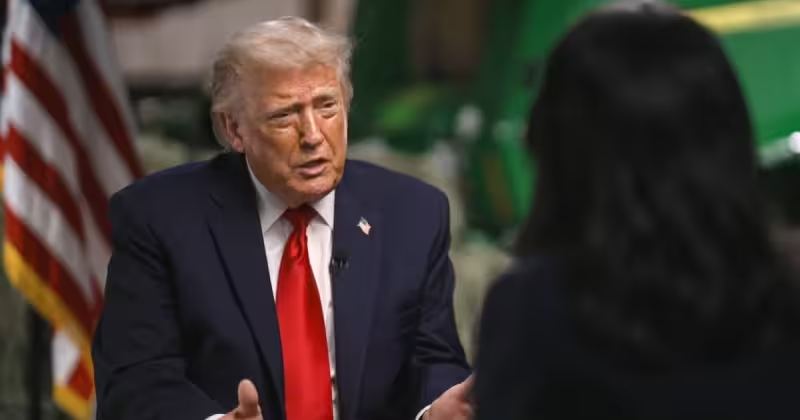
Kristen Welker pressed President Donald Trump on television and elicited a stark choice: make a deal and the United States will help retrieve and destroy Iran’s highly enriched uranium, or refuse and the U.S. will move militarily to secure it. "If we make a deal that now we’re friendly, we’ll all go together. It’ll be our equipment. We’ll take it out and destroy it, whether it’s on-site or whether we take it off-site," Trump said on Meet the Press.
The interview’s clearest moment came when Trump described both the cooperative and coercive paths he envisions. He added that American forces would accompany Iran to remove the material or act without Tehran if necessary, but only when the operation could be done safely: "And we will go with them, or without them. But we won’t have people shooting at us, OK?" He warned that if no agreement is reached, "then we’re going to take them out militarily very harshly. And we’ll wait till we do that before we go, in which case we’ll have safety either way."

Trump spelled out how the United States would monitor any site. He said surveillance would reach into space — "You know, we have cameras on it, all over it. If anybody walked there, if you walked over there, I would be able to read your first name on your lapel" — and invoked the Space Force as part of that capacity. He said the enriched uranium could be destroyed in place or removed and destroyed off-site.
At the same time, Trump told Welker the negotiations were close. "We have a couple of points. They don’t even seem like big points," he said, adding that Iran had conceded it would not have nuclear weapons. He said he wanted explicit language barring Iran from buying, purchasing or acquiring nuclear-weapons material, and that Iran’s new leadership was "Younger. I think more rational," after attacks that killed the former supreme leader and many lieutenants. Trump said he had not spoken directly with the new supreme leader but would meet him "if he’d like to." A separate report said only the U.S. and China could retrieve enriched uranium from some buried Iranian sites after strikes last year described those sites as obliterated.
The remarks arrived amid active military moves in the region. The administration launched Operation Epic Fury on Feb. 28 as part of a three-month-old war, U.S. forces recently shot down four Iranian one-way attack drones near the Strait of Hormuz and later struck coastal radar sites, and Israeli strikes in Lebanon on Friday killed at least six people, according to regional reports. Those operations feed directly into the calculus Trump described: degrade Iranian military capability so American forces can collect nuclear material safely if diplomacy fails.
The friction in Welker’s interview is the story’s engine. Trump insisted he wants a deal and said the two sides were "very close," yet he repeatedly threatened a military fallback that he called both harsh and conditional on force being required. That dual posture — offering to partner with Tehran to remove fissile material while threatening to obliterate Iran’s capabilities if negotiations collapse — raises a practical question Welker’s questioning could not resolve on air: would Iran accept U.S. teams on its soil or the strict non-acquisition clause Trump demands?
Welker’s exchange with Trump crystallized what negotiators now face: a binary the president set out himself. The next, decisive step is whether Tehran will sign the pact Trump described — including language barring purchase or acquisition of weapons material and allowing some form of U.S. involvement in retrieval — or force a confrontation in which U.S. forces would be ordered to "further degrade" Iran’s military so the material can be taken. That unresolved choice is the immediate consequence of Wednesday’s interview and the question the region now has to answer.



