



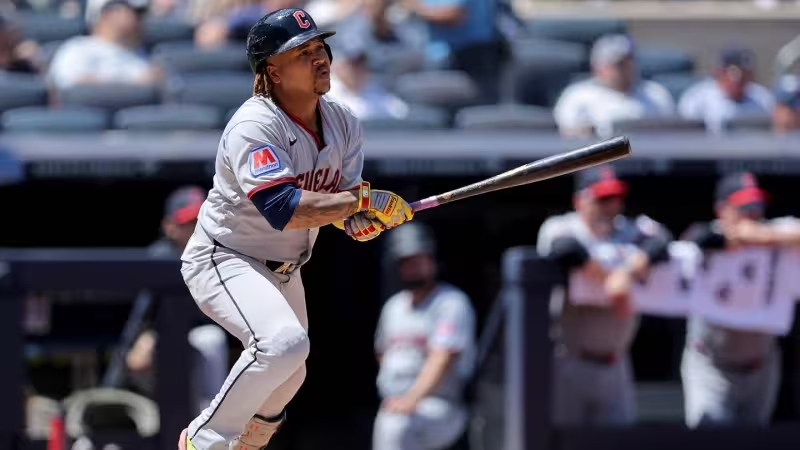
When Aaron Judge suffered a stress fracture in his right rib earlier this week and looked likely to miss most of the summer, José Ramírez answered in the exact way MVP voters evaluate: by showing he can influence a game everywhere on the diamond. Ramírez went 7-for-13 in the Cleveland Guardians' series at Yankee Stadium, with three doubles, a home run, three RBIs and two stolen bases.
The raw numbers underline why the moment matters. Entering the weekend Ramírez carried a.245/.350/.430 slashline, nine home runs and 32 RBI. He led the major leagues with 22 stolen bases and posted 39 walks against 36 strikeouts, a balance that helped produce a 2.2 bWAR — the highest among Cleveland position players.

The Guardians won the series at Yankee Stadium earlier this week, avoiding direct exposure to Judge in that stretch and dropping the series finale on Thursday; a sweep there would have been Cleveland's first since August 2017. Judge's injury, however, is the larger, league-wide development: removing one of the American League's most dominant players creates a rare opening in the MVP conversation midseason.

That opening is not automatic. Ramírez's case is complicated by the numbers that sit uneasily beside his stolen-base totals and run production. His.780 OPS entering the weekend was the lowest mark of his career since 2015, a figure that catches the eye because his peripheral profile — walks, steals, and other underlying metrics — suggests his overall value is higher than the OPS alone implies. Early-season struggles were described by observers as possibly the product of bad luck even as his underlying stats lined up with his previous years.
Which makes Ramírez a classic MVP dilemma: high impact across multiple facets of play, but with a surface-level batting line that looks weaker than past standards. The 2.2 bWAR and the league-leading 22 steals tell voters he is contributing on both sides of the ball; the 39 walks and 36 strikeouts show plate discipline that can sustain value even when batting average slips. His 7-for-13 burst against a team long associated with run suppression at Yankee Stadium illustrates how quickly voters' perceptions can shift when production coincides with a new opening in the field.
The friction is simple and immediate. Judge's absence opens the race; Ramírez's stolen bases and all-around game support a stronger case than his OPS suggests; but his OPS is the lowest since 2015. That gap between headline numbers and underlying value is the story voters will have to resolve over the next months.
Ramírez can control only part of the question. Judge could miss most of the summer, widening the window for another American League player to claim the season's narrative. The single unresolved issue now is whether Ramírez can sustain the mix of extra-base hits, on-base work and base-stealing at a level convincing enough to overtake the remaining MVP contenders — not least because surface stats will be the simplest yardstick for many voters. If he keeps producing the way he did in this series, the vote will no longer be about possibility; it will be about who deserved it.



