



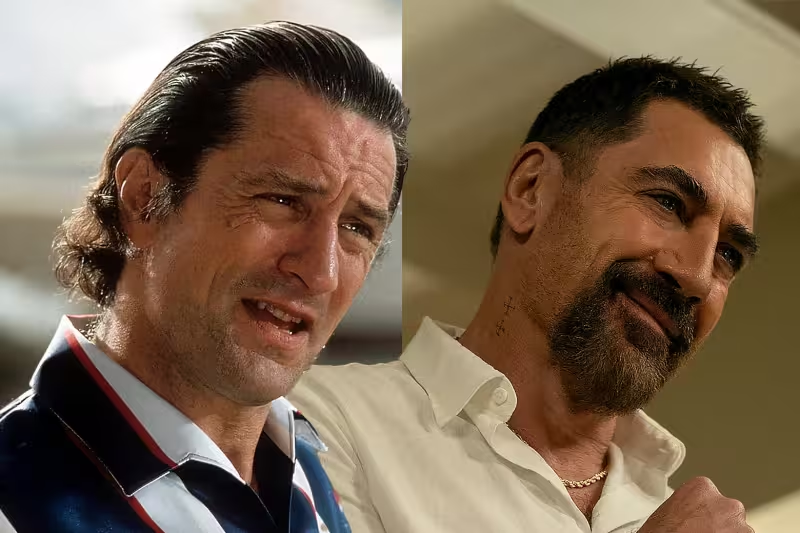
Apple TV’s new Cape Fear miniseries drops its first two episodes Friday, and the moment everyone will be parsing is Javier Bardem’s turn as Max Cady — stretched out across a 10‑hour serialized update created by Nick Antosca and executive produced by Martin Scorsese.
Bardem, 57, comes to Cady a decade older than the actors most closely associated with the role. His Cady is recast as an ex‑restaurateur and a Spanish immigrant to America with a floridly gothic childhood and adolescence — backstory the series explicitly folds into Episode 1, which opens with one woman taking the rap for a murder so Cady can get out of jail.

The scale of the project is the clearest signal of how different this Cape Fear intends to be. Where the story has been a taut, two‑hour showdown in film form, Apple’s package is a 10‑hour television adaptation that updates the Bowdens to suit the times and allows the production to expand motives, histories and the long arc of menace.
The lineage behind that choice is unavoidable: John D. MacDonald’s The Executioners dates to 1957; the first Cape Fear film arrived in 1962 with Robert Mitchum as Max Cady and Gregory Peck as Sam Bowden — Peck had won an Oscar that same year for To Kill a Mockingbird — and Martin Scorsese remade the story in 1991 with Robert De Niro as Cady. De Niro’s performance, often described as Oscar‑nominated and volcanic, still looms large: “I am like God and God like me! I am as large as God! He is as small as I! He cannot above me or I beneath him be!”
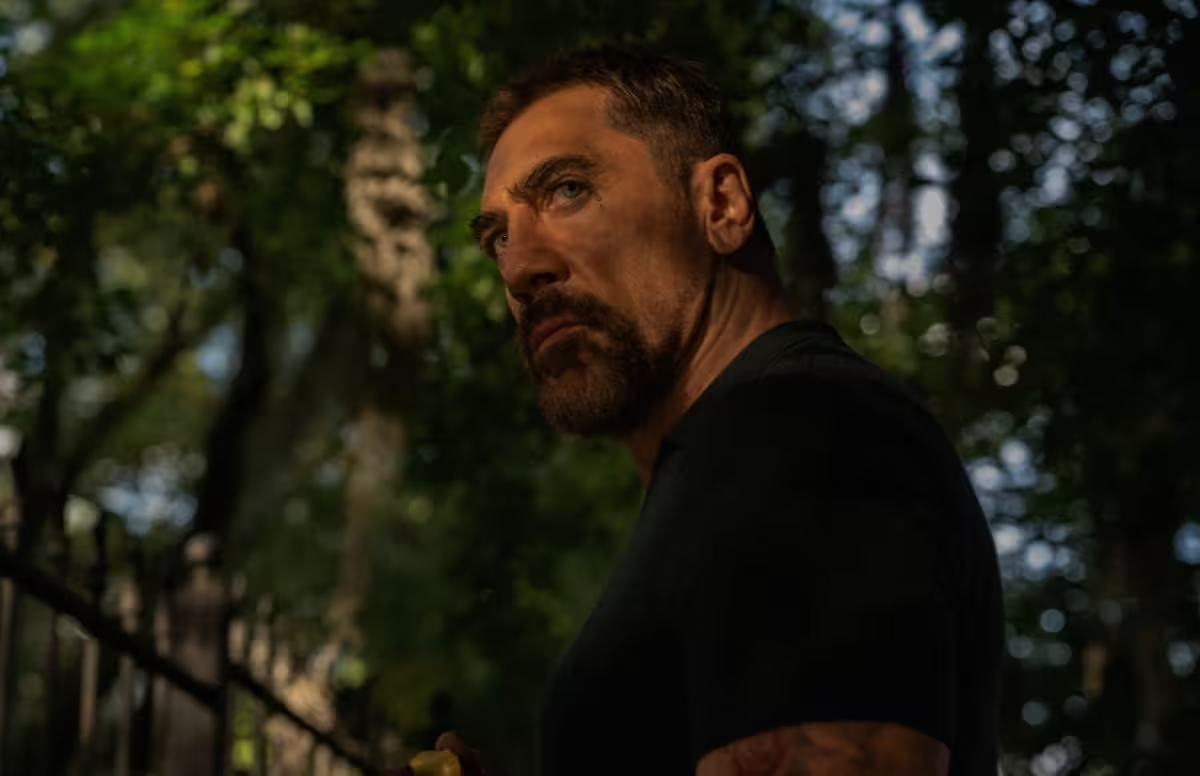

That line is useful shorthand for the problem Apple’s version sets itself: how do you follow a performance viewers already carry in their heads — and now ask a single actor to sustain and modulate comparable menace over many hours? The friction is built into the format. De Niro’s Cady was compact and explosive; Bardem’s must be cumulative, a slow burn that keeps danger fresh for an audience being asked to live with this figure over multiple nights.
What the first two episodes deliver, based on the details released, is an effort to humanize and historicize Cady in ways a film could not. Turning Cady into an ex‑restaurateur and foregrounding his immigrant past lets the series put new grievances and survival strategies on the table. Updating the Bowdens suggests producers are less interested in replaying earlier power dynamics than in testing them against contemporary anxieties.
That approach will be provocative for viewers who come to the series with the films in mind. Fans of the 1962 and 1991 versions know the story as a duel: a single antagonist and a single threatened household. Ten hours changes that geometry. It grants room for the Cady figure to accumulate layers — and it also risks diluting the instantaneous terror that made Mitchum’s and De Niro’s turns so memorable.
The practical question left unresolved on Friday is distribution and pacing beyond the opening pair of episodes: Apple has said the first two episodes arrive Friday, but the release pattern for the remaining hours has not been detailed in the materials made public. The sharper question, though, is artistic: can Bardem hold the center of a story that once burned white hot in two hours, or will the series’ breadth reveal gaps that a film’s compression once hid?
If the first episodes are any guide, this Cape Fear is staking everything on character and slow escalation rather than one sustained shock. For viewers who chase awards‑caliber actors and prestige pedigree — Scorsese’s involvement will summon names like Amy Adams to mind even if she isn’t attached — the gamble is obvious. The rest of the miniseries will decide whether Apple’s longform Cady is an enlargement that deepens the myth or a stretch that leaves the essential menace wanting.



